Laminating reverse‑gravure‑printed BOPP film with PE substrate is a widely‑adopted structure for food and daily‑consumable packaging. A typical stubborn industry defect frequently occurs: finished laminates show perfect appearance, qualified peel strength and zero abnormalities right off production line, yet massive blisters and delamination emerge after 2‑3 months of ambient storage.
This is a typical time‑dependent latent failure. As more converters switch over to water‑based gravure inks, blistering mechanisms differ greatly from traditional solvent‑borne ink systems. Many manufacturers still apply legacy solvent‑ink process parameters, which trigger mass delayed blistering for water‑ink laminates. This article systematically breaks down four root causes and permanent corrective actions for delayed blistering (2‑3 month storage) under both solvent‑borne and water‑based reverse printing conditions.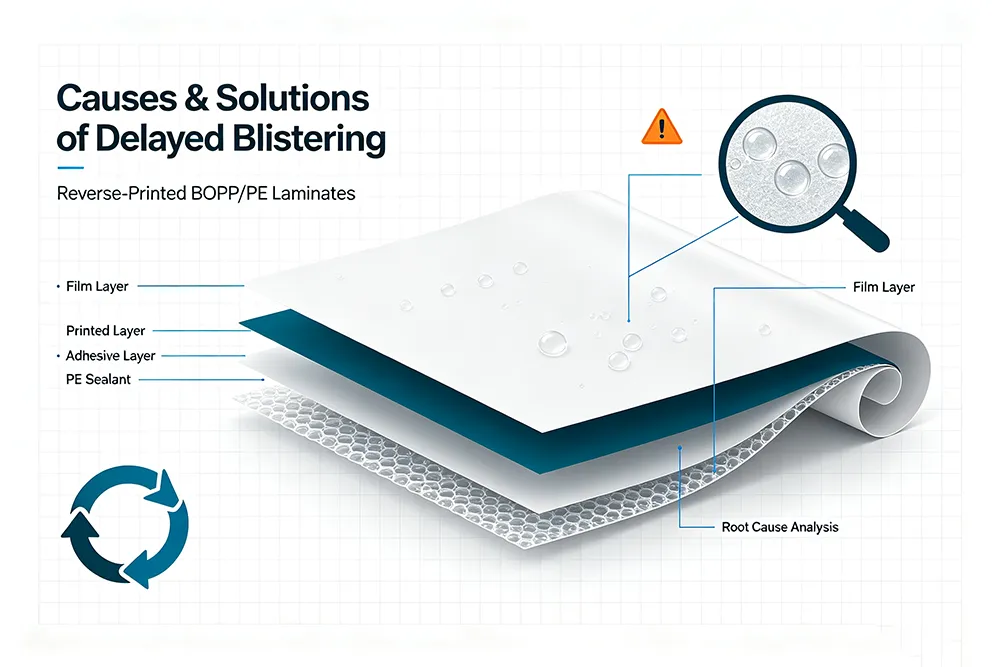
1. Water‑Based Gravure Ink Printing System
Misconception prevails among many converters that water‑based inks contain no organic solvent and are residue‑free, so they cannot induce laminate blistering. This is a critical process misunderstanding. Water‑based gravure inks use pure water as dispersion medium. Compared with ethyl acetate‑based solvent inks, water evaporates much slower. High‑speed gravure production easily creates hidden trapped moisture inside the ink layer without visible symptoms.
BOPP film is non‑absorbent, non‑permeable and moisture‑barrier substrate. After printing, ink surface quickly forms dry skin while micro‑moisture remains sealed underneath the ink coating, totally invisible to naked eyes. Once laminated with PE film, a fully sealed dual‑film structure is formed with no outward moisture escape path.
During long‑term warehousing, ambient temperature fluctuation triggers slow release and vaporization of bound moisture trapped in ink layer. Expanded water vapour accumulates at BOPP / adhesive / ink interface, gradually developing dense micro‑bubbles, cloud‑like hazing blisters and local bulging within 2‑3 months. This defect occurs at very high frequency for heavy solid coverage, thick ink film, high‑speed run and insufficient drying conditions.
Exclusive Solutions for Water‑Based Ink Issues
- Avoid maximum‑speed rush production: Water‑based reverse printing requires far higher drying threshold than solvent‑borne inks. Reduce machine speed, boost oven air volume, raise 2‑stage and 3‑stage drying temperature to achieve thorough through‑drying instead of surface‑only pseudo‑dry.
- Implement 12‑24 hours ventilated maturing dwell time after printing before lamination, to fully release hidden residual moisture. Never laminate printed film immediately after printing.
- Adopt multi‑layer thin‑ink overprinting for solid areas, avoid excessive ink film thickness which locks trapped water.
- Select storage‑stable BOPP reverse‑print dedicated water‑based gravure ink with fast water‑release and low residual tendency.
- Control workshop humidity; activate dehumidification under high‑humidity weather to prevent re‑absorption of moisture by printed ink layers.
2. Traditional Solvent‑Borne Ink Printing System
Insufficient drying for solvent‑borne reverse gravure ink leaves residual ethyl acetate, trace toluene, butanone and other solvents trapped inside ink coating. The sealed BOPP/PE laminate blocks solvent volatilization channels. Residual solvents slowly vaporize and expand over storage duration, prying open composite interfaces and forming irregular‑size blisters mostly concentrated on solid printed areas while blank zones remain intact.
Solutions for Solvent‑Borne Ink Issues
- Cap total solvent residue ≤5 mg/m². Lower ink lay‑down for solid graphics and extend drying duration.
- Restrain over‑dosage of slow‑drying solvents; guarantee complete drying for each printing unit.
- Let printed film sit for maturing to release residual solvent prior to lamination.
3. Incomplete Curing of Lamination Adhesive
Defects from lamination adhesive apply to both water‑based ink and solvent‑ink workflows as a universal root cause for delayed blistering. Wrong mixing ratio for two‑component PU adhesive, insufficient hardener, moisture absorption during glue mixing, inadequate oven temperature and insufficient maturing time will result in incomplete cross‑linking of adhesive layer.
Freshly‑made laminate shows acceptable initial tack and passing peel strength. Nevertheless, incompletely‑reacted adhesive undergoes slow hydrolysis and chain scission in long‑term storage, generating trace carbon dioxide and small‑molecule gas. Interface cohesion deteriorates progressively and eventually brings about debonding, blistering and delamination. This failure is aggravated under humid southern‑China warehousing conditions.
Solutions for Adhesive Curing Problems
- Strictly follow main‑agent / hardener mixing proportion; never arbitrarily cut hardener dosage or reuse expired mixed glue.
- Keep laminating oven temperature stable between 75‑85 °C to ensure full evaporation of solvent or water from coated adhesive layer.
- Perform maturing at 45‑50 °C with sufficient holding time; prohibit early outbound delivery before maturing completes.
- Cool finished rolls naturally down to room temperature after maturing before slitting and packaging; avoid direct sealing of hot rolls into cartons.
4. Accurate Defect Diagnosis & Differentiation
- Blisters concentrate only on solid / graphic printed areas while blank sections stay clean: residual moisture (water‑based ink) or residual solvent (solvent‑borne ink).
- Random blisters spreading over both graphic and blank zones: incomplete adhesive curing or glue layer moisture hydrolysis.
- Oily exudate and whitening haze at separated interface: migration of film additives.
- Delayed blistering newly emerged right after switching to water‑based ink: almost certainly insufficient drying and hidden trapped moisture within water‑based ink coating.
Summary
For reverse‑printed BOPP laminated with PE film suffering 2‑3‑month delayed blistering: latent trapped moisture with slow water vapor release dominates failures for water‑ink processes; vaporization of trapped residual solvent is the key risk point for solvent‑ink workflows. Combined with inadequate adhesive curing and substrate additive migration, these cover all major failure modes.
As packaging industry shifts toward eco‑friendly water‑based printing, most delayed‑storage blistering incidents stem from applying old solvent‑ink high‑speed production parameters onto water‑based ink lines, lacking optimized drying, moisture‑removal and dwell procedures. Targeted upgrade of water‑ink drying workflow, rigorous adhesive maturing management and stable substrate interface control can fundamentally eliminate long‑term storage blistering defects.