In flexographic production of flexible packaging, most batch color deviation complaints are not caused by press operation errors, but unstable consistency of raw ink batches. Most ink suppliers only rely on visual manual color matching and fail to lock fixed Lab spectral data during mass manufacturing, resulting in obvious color shifts between rolls, batches and separate orders. StarColor abandons subjective visual inspection and enforces factory-wide quantitative color control: every batch of finished ink is produced and inspected to guarantee ΔE < 1.0 before shipment.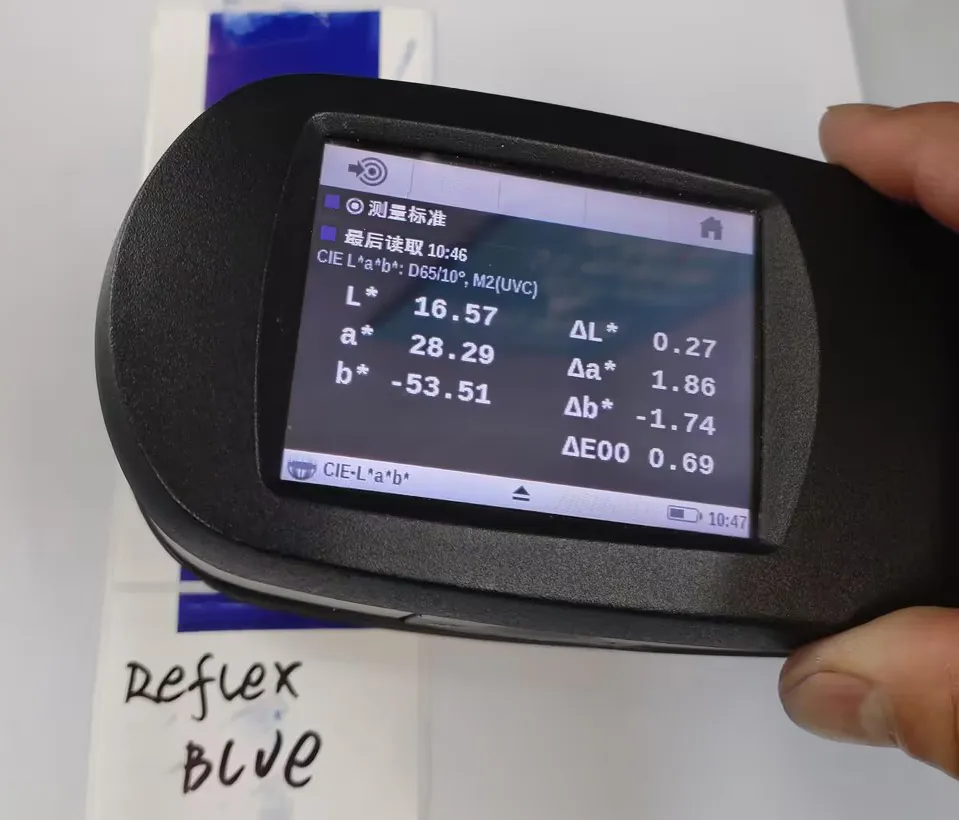
Why ΔE < 1.0 Serves As A Rigorous Industry Quality Threshold
Under professional packaging color management standards, any ΔE value above 1.0 creates color variations visible to the human eye, especially for solid spot colors, brand custom shades and post-retort finished pouches. Conventional ink manufacturers depend on manual color tuning, which inevitably accumulates color deviation over production runs. StarColor adopts full-link digital calibration compliant with CIEDE2000 standards to deliver invisible color difference and data-backed uniform tint performance.
Exclusive Technical Advantages Enabling ΔE < 1.0 Consistency
1. Locked Pigment Particle Size & Dispersion Degree
The majority of inter-batch color drift stems from inconsistent pigment fineness and uneven dispersion. StarColor applies secondary nano-grinding and constant-pressure dispersion processes to fix stable L*a*b* eigenvalues of pigments, eradicating color shifts triggered by varying dispersion results across different batches.
2. Homogenized Base Tone Control for Resin Carriers
Subtle base tone fluctuation of resin carriers is a hidden root of color deviation easily overlooked by ordinary manufacturers. We unify the base color tolerance of every resin batch to eliminate background tint interference, ensuring pure, uniform hue development of color pigments.
3. Closed-Loop Digital Formula Inheritance System
All color formulas are digitally archived with fixed proportional parameters. Random manual adjustments during mass production are prohibited. Each new batch is reproduced strictly against standard spectral reference data, completely removing inter-batch color inconsistency at the source.
4. Full Spectral Inspection Before Factory Release
Every ink lot undergoes complete spectral scanning prior to delivery. Only batches measured with ΔE < 1.0 are approved for shipment. Non-compliant products go through full rework, eliminating all color deviation risks for printing converters before materials reach their production lines.
Tangible Production Benefits For Printing Converters
- No roll-to-roll color jumping, stable spot color output for long continuous print runs
- No color shift after post-processing including lamination, frozen storage and high-temperature retort sterilization
- Minimal on-press color adjustment required, cutting machine downtime and material waste
- Fully compliant with strict color tolerance rules of global high-end brands, ideal for export food packaging orders
Conclusion
Consistent color performance cannot be guaranteed merely by experienced manual tuning. It relies on standardized fixed formulas, locked dispersion workflows and rigid data-based factory acceptance thresholds. With persistent full-batch color control targeting ΔE < 1.0, StarColor supplies zero-shift, highly repeatable ink solutions to printing plants, fundamentally resolving the long-standing industry pain point of unstable batch color.