Mechanism of Corona Decay and Its Impact on Adhesion of Water-Based Flexo Inks for PE & PP Films
In mass flexographic production of flexible packaging, most printing plants only check the corona value at startup. As long as the initial reading reaches 42–48 dyn/cm, the substrate is deemed qualified. However, the industry frequently encounters hidden recurring defects: perfect printing at startup, massive ink peeling after line shutdown and restart, widespread delamination after rolls are stored for 24–72 hours, and complete adhesion failure after low-temperature lamination. The root cause of these issues rarely lies in ink quality, but rather corona treatment decay.
Corona activation is not a permanent substrate modification, but a time-sensitive physical and chemical surface activation process. Polyolefin films such as PE and PP inherently suffer from surface energy rebound, inward migration of polar functional groups, and blooming of slip additives. This article analyzes how corona decay destroys ink adhesion from five dimensions: micro-mechanism, attenuation cycle, accelerating factors, corresponding production failures, and on-site control standards, and provides actionable process control solutions for printing factories.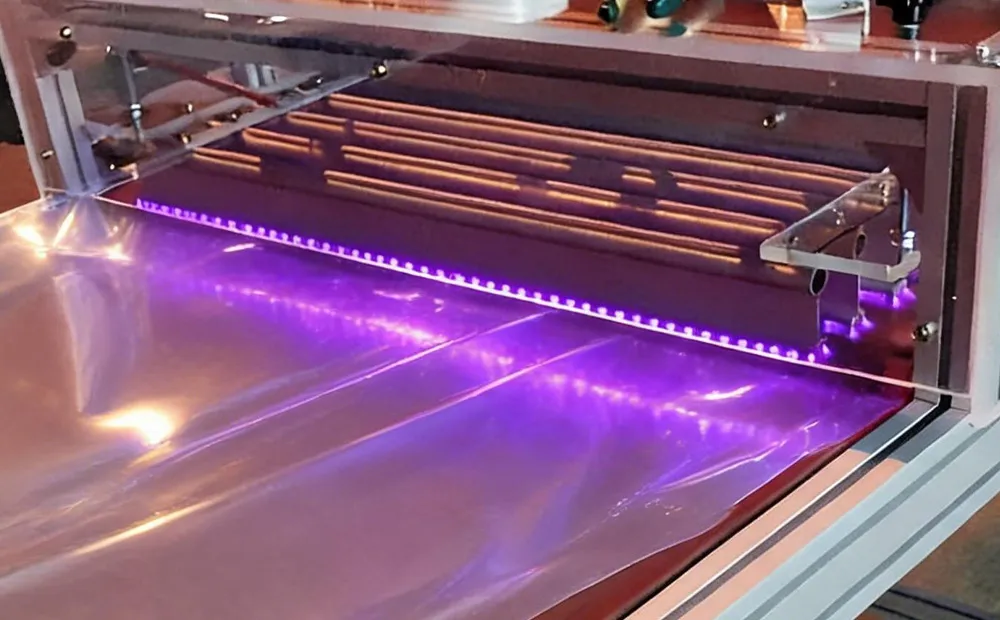
1. True Microscopic Principle of Corona Activation (Underlying Logic of Adhesion)
PE and PP films are inert materials with extremely low surface energy. Their molecular chains carry no polar groups or adsorption sites, making them impossible for water-based flexo inks to wet and anchor on.
High-voltage corona discharge serves two core functions only:
- It breaks down air on the film surface and generates ozone and ionic oxidation reactions, forming polar functional groups including hydroxyl, carboxyl and carbonyl groups within a 5–10 nm surface layer of the film. These groups form chemical anchor points for ink bonding.
- It creates micro-etching on the substrate surface to raise surface tension and improve ink wetting and leveling performance.
A common misconception among printing plants is that corona treatment merely roughens the film surface. The actual core function is grafting polar functional groups. Once these polar groups disappear, the ink will fail to adhere even if the surface looks visibly rough to the naked eye.
2. Three Microscopic Mechanisms of Corona Decay (Why Ink Peeling Occurs Even with Qualified Initial Corona Values)
Corona decay is more than a simple drop in dyn reading. It involves three irreversible microscopic failure pathways, which explain the industry-wide headache of qualified lab samples yet defective bulk production runs.
2.1 Hydrophobic Rebound of Molecular Chains (Primary Root Cause)
The polar functional groups forcibly grafted by corona treatment are thermodynamically unstable. To restore the material’s minimum energy steady state, film molecular chains spontaneously rearrange: polar surface groups migrate inward, while non-polar hydrophobic inner chains flip to the outermost surface, a phenomenon known as hydrophobic recovery.
This rearrangement initiates immediately after corona treatment completes. A rapid attenuation phase sets in within 2–6 hours under ambient temperature, eliminating chemical anchor points for ink and causing a sharp drop in adhesion strength.
2.2 Continuous Blooming of Slip & Anti-Block Additives
Nearly all commercial PE and PP packaging films incorporate slip agents, anti-block additives and opening agents. Corona can remove surface precipitates temporarily, yet it cannot stop continuous inward-outward migration of internal additives.
Typical production phenomenon: zero ink peeling within the first 2 hours of printing. After 4 hours of continuous operation, additives constantly bloom to form an isolating layer on the film surface, breaking the bonding interface between ink and substrate and resulting in mottling, pinpoint delamination, and wipe-off ink loss.
2.3 Accelerated Degradation Triggered by Ambient Temperature & Humidity
High temperature, high relative humidity and UV radiation directly break surface oxidized functional groups and speed up polar group degradation. During humid rainy seasons and hot summer workshop conditions, corona decays 2–3 times faster than in winter, which is the key driver of soaring reject rates in damp environments.
3. Real-World Corona Decay Cycles of PE & PP Films (Verified Factory Production Data)
Measured attenuation trends under standard workshop conditions (23°C, 50% RH), fully matching flexo mass production workflows:
- 0–1 h: Optimal printing window
Corona value remains 42–48 dyn/cm with maximally stable polar groups. Ink adhesion and wetting performance reach peak levels with no hidden delamination risks. - 1–6 h: Rapid attenuation stage
Surface energy falls back to 38–42 dyn/cm. No obvious printing defects are visible to the naked eye, yet local ink peeling will occur under low temperature, friction or light compression. - 6–24 h: Critical failure threshold
Most films drop to 36–38 dyn/cm. Although this reading appears marginally acceptable, massive loss of polar anchor points drastically weakens water-based ink adhesion, leading to blocking and delamination after rewinding. - Over 24 h: Complete surface deactivation
PP films can suffer over 15% corona loss, reverting to an inert surface state. No ink grade, regardless of premium quality, can achieve reliable adhesion.
Key Conclusion: PP decays far faster than PE. Overnight stored PP rolls must never be sent directly to printing presses.
4. Four Major Production Defects Induced by Corona Decay (Matching On-Site Failures)
90% of the following failures are misdiagnosed as ink quality issues, while the real trigger is time-dependent corona decay:
- Perfect print at startup, mass ink peeling after shutdown and restart
After 1–3 hours of line halt, surface polar groups rebound and additives bloom, silently lowering surface energy and preventing new ink layers from anchoring firmly. - Pass cross-hatch test at room temperature, delamination after frozen storage
The weakened adhesive interface formed under decayed corona cannot withstand shrinkage stress at low temperatures, causing cracking and full sheet peeling of the ink film. - Flawless printed surface, blistering, delamination and re-solubilization peeling after lamination
Insufficient interfacial bonding from corona decay allows adhesive solvents to penetrate the boundary and destroy the weakly bonded ink layer. - Inconsistent color and adhesion along the same roll of film
The outer layers of the roll are exposed to air for longer periods with severe decay, while inner wrapped layers retain stable corona activation, resulting in uneven adhesion across the full roll.
5. Industry Misconception: Only Focus on Startup Dyn Value, Ignore Dynamic Decay Tolerance
Conventional universal water-based inks rely heavily on high corona readings to maintain adhesion. Minor corona attenuation will immediately trigger adhesion failure.
This explains why many printing plants experience intermittent mass rejects even with qualified corona readings, compliant ink batches and standardized process parameters.
The solution does not lie in endlessly boosting corona power, but two core measures:
- Implement strict printing time window limits to avoid printing expired rolls;
- Select specialized inks with high corona tolerance, anti-additive-blooming properties and interfacial activation formulas to compensate for interfacial defects caused by corona decay.
6. Practical On-Site Control Protocols for Printing Plants (Eliminate Adhesion Failures from Corona Decay)
6.1 Mandatory Time Window Control (Most Cost-Effective Solution)
The optimal printing window opens within 1 hour post corona treatment, with a maximum allowable waiting time of 6 hours. PP films must be corona treated and printed on the same shift; overnight storage is prohibited. Any rolls stored over 24 hours require re-corona treatment and re-testing before printing.
6.2 Dynamic Corona Value Control Instead of Static Spot Checking
Mass production standard: maintain a stable 38–42 dyn/cm range throughout production, instead of chasing inflated 48 dyn/cm readings. Excessively high corona power accelerates surface aging and creates brittle film layers, which actually degrade adhesion performance.
6.3 Ambient Temperature & Humidity Management
Shorten roll standby time under high-humidity conditions. Do not leave film rolls exposed to open air for extended periods when workshop RH exceeds 65%.
6.4 Matching Specialized Anti-Decay Ink Systems
For production conditions featuring corona decay, additive blooming and unstable surface energy, the following ink systems are mandatory:
- PP-specific interfacial activation inks: actively build chemical anchoring sites to compensate for insufficient surface polarity;
- Anti-slip-agent-blooming formulations: penetrate the isolating additive layer to achieve deep substrate adhesion;
- High-tolerance water-based flexo systems: stable performance under low corona conditions of 38–42 dyn/cm, preventing peeling triggered by minor corona loss.
7. Conclusion
Corona treatment is not a permanent substrate modification technology. It delivers time-sensitive, reversible surface activation prone to rapid decay. The vast majority of poor adhesion issues in PE & PP flexo printing do not stem from substandard inks, but from manufacturers overlooking the microscopic failure mechanism and time window limits of corona decay.
Reliable ink adhesion = Optimal printing time window + Dynamic corona value control + Decay-compatible specialized inks. Only the combination of these three elements can completely resolve chronic industry pain points including intermittent ink peeling, low-temperature delamination, lamination failure and bulk production rejects.