Liquid food is the most demanding category in packaging print. The contents are heavy, they move, they contain water, fat, alcohol or acid, and they usually go through a thermal process before they reach the shelf. An ink that prints beautifully on a dry snack bag can fail every one of those tests at once.
That is why ink selection for liquid food and beverage packaging should start from the process, not from the price list. The same brand can involve three different ink systems across its range — a water-based system on the paper carton, a lamination-grade system inside the retort pouch, and a UV system on the shrink sleeve around the bottle. Below is the selection logic we use with converters, organized by package format, thermal process and compliance rule.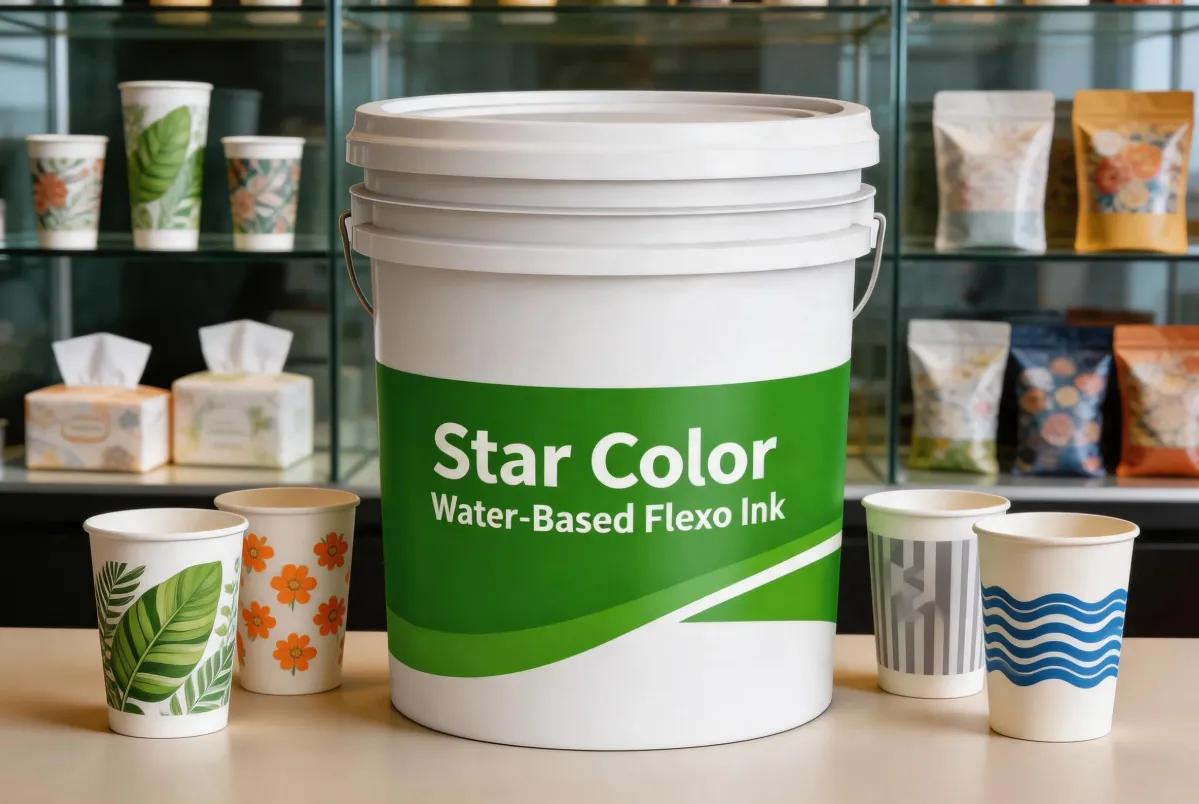
1. Four Package Formats, Four Different Jobs
"Liquid food packaging" covers several structures with very different expectations of the ink layer:
| Format | Typical Structure | Printing Process | What the Ink Must Survive |
|---|---|---|---|
| Aseptic gable-top carton | Paperboard + PE / barrier layers | Water-based flexo (paper side) | Roll storage set-off, humidity, low odor, food-contact compliance |
| Retort pouch / DOY pack | PET//AL//CPP or PET//CPP laminate | Reverse gravure on inner film | 121 °C steam, pressure cycling, lamination bond, flex cracking |
| Pasteurized chilled packs | PE films, paper labels on bottles | Water-based flexo / gravure | Hot-water immersion, condensation, refrigeration cycling |
| Pet food pouch | Film laminate, often foil-based | Reverse gravure | Fat-rich contents, retort or pasteurization, puncture and flex |
If you know which row your job belongs to, half the selection work is already done. The other half is the thermal process.
2. Match the Ink to the Thermal Process
Aseptic filling: the ink never sees 121 °C — but that is not a free pass
In aseptic filling, the package is sterilized and filled in a sterile environment; the UHT-treated product never cooks inside the package. The printed ink layer therefore avoids retort temperatures. What it does get instead:
- Roll storage and set-off exposure. Carton blanks are printed, stacked and wound long before filling. Ink that blocks or offsets under stack pressure transfers to the food-adjacent side — the classic liquid-carton failure.
- Humidity and condensation. Cold-chain storage puts water on the outside of the pack.
- Odor discipline. Aseptic products are aromatic-sensitive; residual solvent and monomer odor from the ink layer is a rejection criterion, not a nice-to-have.
Water-based flexo on the paper layer — our SC1000 paper flexo series, including the food contact grade SC1000-FOOD — is the mainstream choice here precisely because it dries solvent-free and keeps set-off manageable at carton converting speeds.
Pasteurization: hot water is a test protocol of its own
Pasteurized chilled beverages, sauces and ready-to-drink products pass through hot-water baths or steam tunnels in the 63–95 °C range, then go straight into refrigeration. The printed surface must survive:
- Immersion in hot water without smearing, bleeding or edge crawl
- Condensation during cooling — the moment when a poorly bound ink film lifts
- Repeated cold-warm cycling for the rest of the shelf life
This is a wet-rub and immersion test, not a dry rub test. When you specify the job, say "pasteurized, water bath, <X °C" explicitly — suppliers will otherwise quote for dry-rub performance and the difference shows up as smeared pallets, not in the lab.
Retort: the stress test that decides the formulation
Retort sterilization runs at approximately 121 °C for 20–60 minutes in saturated steam with overpressure, followed by pressure-controlled cooling. Inside a reverse-printed laminate the ink layer is sandwiched between the outer film and the sealant — protected from the food, but exposed to every physical stress of the cycle:
- Heat and color stability — pigments and binders must not shift or yellow at sterilizing temperature
- Blistering resistance — trapped volatiles expand under steam and pressure; blistering in the laminate is the most common retort defect (see our guide on delayed blistering in reverse-printed BOPP/PE laminates)
- Lamination compatibility — ink components must not weaken the adhesive bond; a retort pouch that delaminates in the autoclave is a packaging failure, not just a print failure
- Flex-crack resistance — pouches are folded, gripped and dropped
For this format we work with the SC5000 film gravure series and our water-based gravure lamination ink, and we ask for the full retort schedule before quoting — see the checklist in section 6.
3. Migration Rules That Apply Whatever the Process
Thermal process decides how tough the ink must be; migration rules decide what it may be made of. Those rules do not change between aseptic, pasteurized and retort:
- EU: Framework Regulation (EC) 1935/2004 plus the GMP Regulation (EC) 2023/2006, evaluated against specific migration limits using food simulants (3% acetic acid, 10% and 95% ethanol, vegetable oil) — with attention to non-intentionally added substances (NIAS)
- US: FDA 21 CFR 175–176 for paper and board components in contact with aqueous and fatty foods
- China: GB 4806 series, including the dedicated standard for food-contact printing inks
Two practical points matter more than the citation list. First, set-off is the number-one migration route in liquid food converting: tight-wound rolls and stacked sheets put printed surface against food-adjacent surface for weeks, and whatever transfers has bypassed every barrier you designed. Anti-set-off formulation and proper drying are compliance tools, not print-quality details. Second, fat changes everything: fatty simulants extract far more than aqueous ones, which is why pet food and dairy-fat products are the strictest briefs in this category.
For the direct-contact vs. behind-barrier distinction — and which documents each one requires — see our direct vs. indirect food contact ink guide and our overview of PPWR & PFAS-compliant ink choices for EU packaging export. Our gravure water-based system's FDA test report is summarized in this article.
4. Matching the Series to the Layer
| Layer / Component | Key Requirement | Series Direction |
|---|---|---|
| Paper carton outer print (aseptic, chilled) | Low odor, set-off control, humidity resistance | SC1000 paper flexo / SC1000-FOOD food contact grade |
| Film laminate reverse print (retort, DOY) | Retort stability, lamination bond, flex cracks | SC5000 film gravure; lamination-grade water-based gravure |
| Flexible pouch film printing (pasteurized) | Wet-rub, immersion, film adhesion | SC2000 film flexo or SC5000 film gravure |
| Beverage labels & shrink sleeves | Condensation, curl, high-speed application | SC2000 / UV7100 shrink-sleeve flexo, UV7000 for general label work |
Series names follow our standard line: SC1000–SC3000 are water-based flexo grades for paper, film and non-woven, SC4000–SC6000 the matching water-based gravure grades; suffixes indicate the duty, with -FOOD marking the food-contact grade. Where UV is the right chemistry — shrink sleeves and high-speed labels — the UV7100 and UV7000 series carry that work.
5. Pet Food: The Fat Question
Pet food pouches deserve their own paragraph because they combine the hardest variables in this category: fat-rich contents (fatty simulants, aggressive extraction), thermal processing (many wet pet food lines are retort), puncture and flex stress (sharp kibble, rough logistics) and long shelf life. Converters who treat pet food as "just another pouch" usually meet trouble first in odor and migration, not in print quality.
The practical consequences: specify the contents' fat profile honestly, test against fatty simulants, and treat the lamination bond as a safety component rather than a print detail. The packaging integrity principles are the same as those in our food packaging ink application page.
6. Six Things to Tell Your Ink Supplier
Liquid food jobs fail in quotation, not in production, when information is incomplete. A workable brief covers:
- Full structure — every layer, including barrier, sealant and print side
- Thermal process schedule — temperature, time, pressure, cooling method (or "aseptic", or pasteurization bath profile)
- Content profile — water / fat / acid / alcohol, filling temperature, shelf life
- Compliance target — destination market and required documentation (FDA, EU, GB), plus any customer audit
- Line reality — press type, speed, anilox or cylinder specification, lamination equipment
- Acceptance tests — which simulants, which rub or immersion protocol, which results count as pass
With that brief, a supplier can respond with a TDS and a test protocol instead of a promise — and you can hold the second batch to the first. Our TDS library covers the water-based and UV series, how to order explains samples (5 kg dispatched within 72 hours) and lead times, and if the color needs matching first, start with the color matching service. To budget ink demand for a new liquid food line, the ink usage calculator gives a planning number in seconds.
7. Conclusion
For liquid food and beverage packaging, the correct sequence is: format first, thermal process second, migration rules third, chemistry last. Aseptic cartons reward low-odor, set-off-stable water-based flexo; pasteurized packs are won or lost on wet-rub and immersion; retort laminates are a formulation exercise in heat, pressure and bond survival; and pet food stacks all of those demands with fat on top. Bring the process schedule to the ink conversation and the ink conversation gets short, cheap and boring — which is exactly what a packaging launch should be.