Who this is for: Packaging converters, ink manufacturers, and food & beverage brand owners exporting to the EU
Starting 12 August 2026, the EU Packaging and Packaging Waste Regulation (PPWR, EU 2025/40) Article 5 comes into force. It doesn't just cover the packaging itself — printing inks, coatings, adhesives, and substrates all fall under its scope. Any packaging placed on the EU market is subject to these rules.
For flexo label printers, two numbers matter most: the 100 mg/kg combined heavy metal limit and the new PFAS thresholds for food-contact packaging. Here's a breakdown.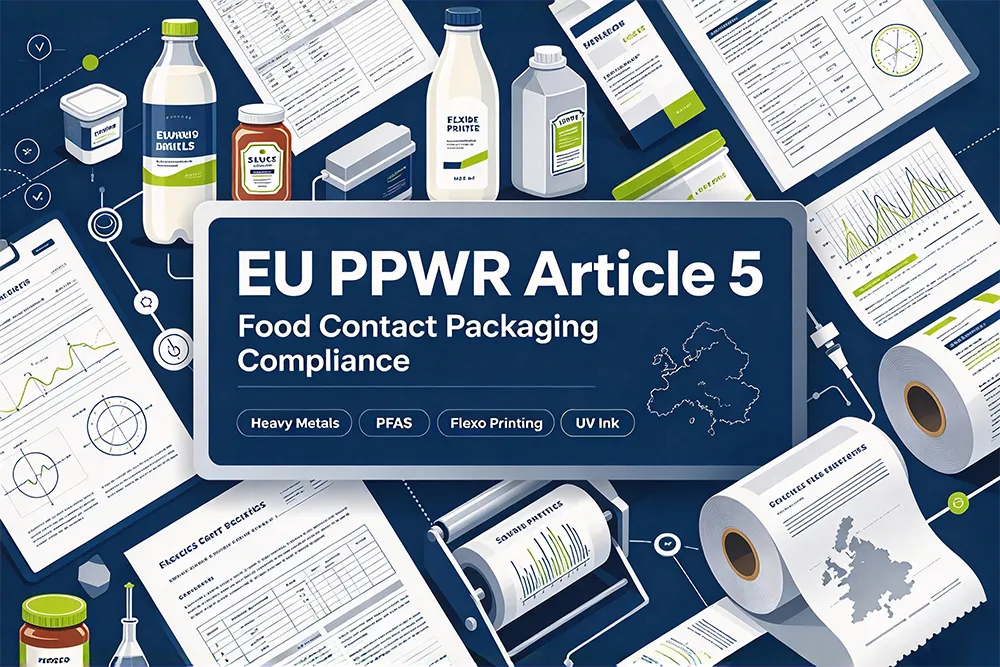
1. Heavy Metals: Pb + Cd + Hg + Cr(VI) Combined Limit of 100 mg/kg
This requirement applies to all packaging types, not just food-contact grades. The sum of lead, cadmium, mercury, and hexavalent chromium must not exceed 100 mg/kg (100 ppm) by weight.
A few things that are easy to get wrong:
- This is a combined limit, not a per-metal limit. Testing must be done at the component level, including printed ink layers — not just the base substrate.
- The rule inherits its core concept from the old Packaging Directive (94/62/EC), but PPWR tightens conformity assessment obligations. Suppliers need to retain test reports, declarations of compliance, and material change records.
- High-risk areas for printers: coloured pigments, recycled substrates, functional coatings, and low-cost raw materials. Ink manufacturers must screen pigment batches to prevent heavy metal carry-over into finished labels.
- Recommended test method: CEN CR 13695-1.
What this means for label printing: Even a thin flexo UV ink film contributes to the total heavy metal count. Ink suppliers need to provide full elemental screening to demonstrate that the printed component stays under the 100 mg/kg aggregate limit.
2. New PFAS Thresholds for Food-Contact Packaging
PFAS (per- and polyfluoroalkyl substances) restrictions apply only to food-contact packaging — including sauce, beverage, and milk bottle labels — also effective 12 August 2026. The regulation covers both intentionally added and unintentionally present PFAS. Article 5(5) sets three tiers:
| Tier | Threshold | Notes |
|---|---|---|
| Individual targeted PFAS | < 25 ppb | Polymeric PFAS excluded |
| Sum of targeted PFAS | < 250 ppb | Including degradable precursors; polymeric PFAS excluded |
| Total PFAS | < 50 ppm | Including polymeric PFAS. If total fluorine exceeds 50 mg/kg, manufacturers must supply documentation proving fluorine origin and PFAS quantification. |
A common misconception: PFAS limits apply to the finished food-contact packaging component, not merely the ink raw materials. Common sources of unintended PFAS contamination include defoamers, slip additives, release agents, and contaminated recycled feedstock. Traditional water-based repellent coatings used for oil and sauce resistance are a major risk point for condiment labels.
3. What Flexo Food Label Printers Are Up Against
Condiment, soft drink, and dairy bottle labels face some specific risks under PPWR:
- Multilayer label construction: Adhesive, topcoat, printing ink, and film substrate are separate components — each must be assessed independently.
- Functional additives: Oil-resistant topcoats for soy sauce labels have historically relied on fluorinated additives, which can trigger PFAS exceedance.
- Batch variation: Recycled PET/PE bottle stocks may carry residual heavy metals or fluorine contamination.
- Documentation burden: Importers require an EU Declaration of Conformity plus supporting lab test data. Generic supplier statements are no longer accepted for high-risk food-contact applications.
These pressures are driving strong market demand for PFAS-free, low-heavy-metal flexo UV inks for beverage and condiment label applications.
4. Ink Selection: Meeting Article 5 Requirements
To satisfy both the heavy metal and PFAS limits, packaging converters should work with ink suppliers that have fully audited formulation control. Key points:
- Heavy metal control: Use heavy-metal-free pigment systems, batch screening, and incoming raw material QA to ensure the ink film does not push the packaging component over the 100 mg/kg combined threshold.
- PFAS elimination: Fully fluorine-free formulations with no PFAS-containing slip, wetting, or anti-oil additives. For sauce-resistant labels, switch to non-fluorine barrier topcoats.
- Full traceability: Supplier Declaration of Compliance, batch test certificates, REACH and food contact compliance packages (compatible with EU 1935/2004).
- Print performance retention: Maintain adhesion, scratch resistance, and chemical resistance against vinegar, soy, dairy, and beverage fluids without fluorinated additives.
Take Zhongzhixing StarColor flexo UV label inks as an example. The formulations are designed to meet PPWR Article 5 requirements: aggregate heavy metals well below 100 mg/kg, zero intentionally added PFAS, and validated for PPWR food-contact label applications on PE/PET beverage, milk, and condiment bottle labels.
5. Conformity Assessment & Test Workflow
Recommended workflow for label converters exporting to the EU:
- Break down packaging into individual components: substrate, ink, adhesive, overprint varnish.
- For each component: obtain raw material declarations and third-party testing.
- Heavy metal test: quantify Pb, Cd, Hg, Cr(VI) sum.
- PFAS screening: start with a total fluorine test. If TF > 50 ppm, perform targeted PFAS analysis.
- Maintain technical file + EU DoC, available for inspection by EU market authorities.
- Implement change control: any ink, varnish, or substrate formulation change triggers re-verification.
Conclusion
PPWR doesn't just update the old heavy metal rules — it adds ultra-low PFAS thresholds that are reshaping food-contact label printing for beverage and condiment brands. The 100 mg/kg heavy metal total limit and the three-tier PFAS regime demand full component-level control, starting from ink formulation. Printers and brand owners need to move from passive compliance to proactive raw material qualification, especially for sauce, drink, and milk bottle labels. Selecting PPWR-ready, PFAS-free flexo UV inks is the most direct route to avoiding border holds, product recalls, and commercial losses in the EU market.
This article is for general information only. For specific compliance decisions, consult legal or testing professionals.