Vegetable-based ink and water-based ink are both popular alternatives to traditional solvent-based inks. However, many printers mistakenly assume that “vegetable-based” automatically means “water-based,” leading to poor press compatibility, unstable quality, or unnecessary cost increases.
The key difference lies in how they are classified: water-based ink is defined by its dispersion medium, while vegetable-based ink is defined by its raw material origin. They overlap—but they are not the same.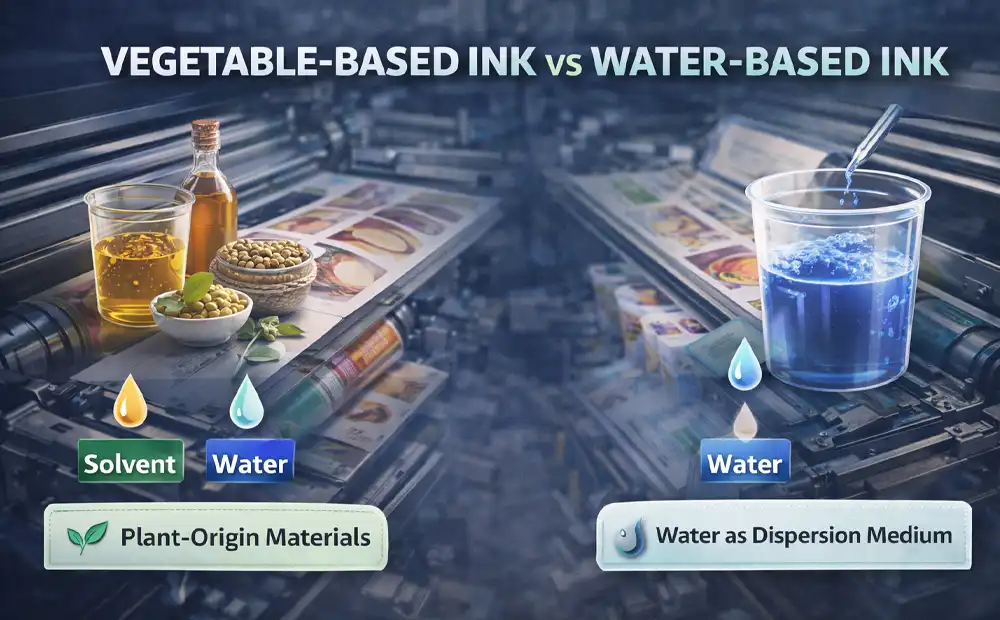
1. Core Definitions
Water-Based Ink: Defined by Water
Water-based ink uses water as the primary dispersion medium (typically 40–60%), replacing most organic solvents. Regardless of whether the resin is petroleum-based or plant-derived, if water is the main carrier, it is classified as water-based ink.
Most food packaging flexographic inks fall into this category. Some formulations may contain small amounts of vegetable components, but they remain water-based inks by definition.
Vegetable-Based Ink: Defined by Plant-Origin Materials
Vegetable-based ink is classified by its raw materials. If key components are derived from renewable plant sources (such as soybean oil or linseed oil), it is considered vegetable-based—regardless of whether water is used.
Vegetable-based inks can be water-based or solvent-based. Some plant-based inks contain no water at all.
2. Formulation Differences
Dispersion Medium / Solvent
- Water-Based Ink: Water as the main carrier, with small amounts of alcohol co-solvents to adjust viscosity and drying speed.
- Vegetable-Based Ink: Either water-based (with plant-derived resins) or solvent-based using vegetable oils as carriers.
Resin Systems
- Water-Based Ink: Mostly synthetic acrylic resins—mature technology, broad compatibility, lower cost.
- Vegetable-Based Ink: Plant-derived resins or oils, often used in biodegradable packaging systems.
3. Performance and Press Compatibility
Drying Speed
- Water-Based Ink: Dries by water evaporation and film formation. Typical surface drying: 2–5 seconds under standard conditions. Suitable for high-speed flexo and gravure printing.
- Vegetable-Based Ink:
- Water-based vegetable ink: 10–20% slower drying than conventional water-based ink.
- Solvent-type vegetable ink: Dries via oxidative polymerization; significantly slower and often requires infrared drying.
Substrate Compatibility
- Water-Based Ink: Compatible with paper, paperboard, nonwovens, and plastic films. Adhesion on films can reach 4B or higher with proper formulation.
- Vegetable-Based Ink: Excellent adhesion on paper substrates (up to 5B), but limited performance on non-absorbent films without primers.
Weather Resistance and Biodegradability
- Water-Based Ink: Standard grades show limited UV resistance; enhanced versions require additives.
- Vegetable-Based Ink: Better UV stability and natural degradability, making it suitable for compostable packaging.
4. Applications and Cost Comparison
Typical Applications
- Water-Based Ink: Food packaging, paper cups, plastic bags, nonwoven bags, cartons—especially high-volume orders.
- Vegetable-Based Ink: Biodegradable packaging, eco-labeled products, premium or EU-export packaging.
Cost (Indicative)
- Water-Based Ink: Approximately USD 2,100–3,500 per metric ton.
- Vegetable-Based Ink: Approximately USD 3,500–5,600 per metric ton, about 1.5–2× higher.
5. Practical Selection Advice
- High efficiency and broad compatibility: Choose water-based ink.
- Fully biodegradable or premium eco requirements: Choose vegetable-based ink.
- Balanced sustainability and productivity: Water-based vegetable ink is a promising middle ground.
Conclusion
The difference between vegetable-based ink and water-based ink lies in classification logic, not environmental claims. Water-based ink focuses on the dispersion medium (water), while vegetable-based ink focuses on raw material origin.
Ink selection should be based on substrates, production speed, regulatory requirements, and cost targets—not marketing buzzwords. For efficiency, choose water-based ink; for full biodegradability, choose vegetable-based ink.