Color consistency and printing stability are critical quality indicators in gravure printing, especially for food packaging and premium consumer packaging. Issues such as batch-to-batch color variation, ink blocking, and dot distortion often result in high waste rates and increased production costs. One of the most decisive factors behind these problems is ink performance.
Starcolor water-based gravure inks are engineered to address these challenges at their root, delivering stable color reproduction, reliable high-speed performance, and regulatory compliance for modern packaging printers.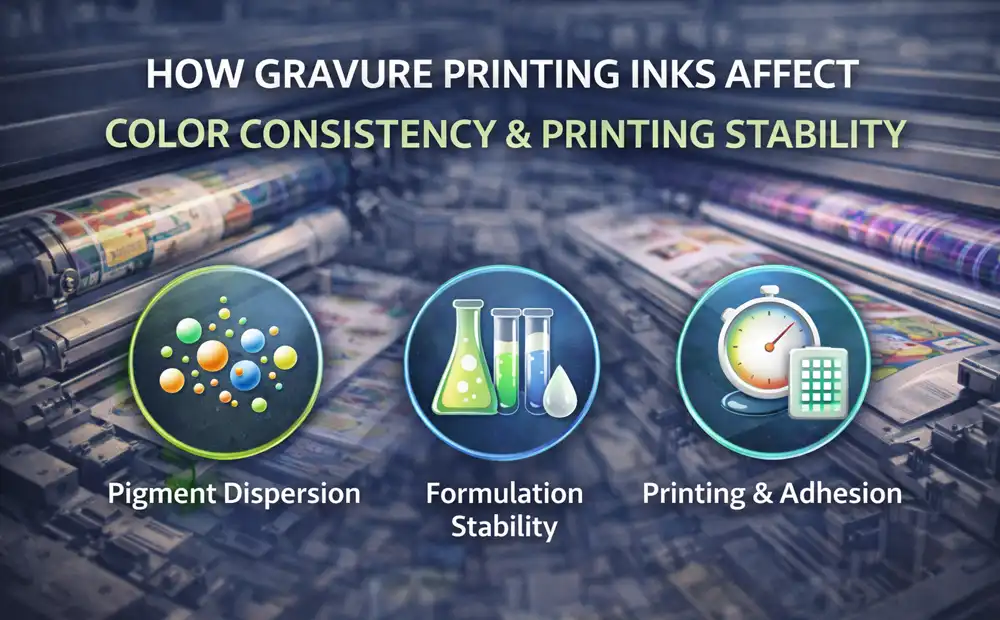
1. How Inks Control Color Consistency: Uniformity and Stability
Pigment Dispersion Uniformity
Pigment dispersion directly determines color purity and uniformity. Inadequate dispersion leads to pigment agglomeration, causing color specks, uneven density, and gravure cell clogging.
Starcolor water-based gravure inks use nano-level dispersion technology, controlling pigment particle size at 0.5–1.0 μm with a narrow distribution range. This ensures clean, uniform color and consistent performance across production batches. In real packaging applications, batch-to-batch color deviation remains at ΔE ≤ 0.8, well below the common industry tolerance of 1.5.
Formulation Stability During Printing
Ink viscosity and pH fluctuations during printing can cause color drift, especially in hot and humid environments common in Southeast Asia. Conventional water-based inks often suffer from instability under these conditions.
Starcolor inks employ a star-structured acrylic resin system, maintaining viscosity fluctuation within ±5% over 24 hours at temperatures between 20–40°C. pH remains stable within the optimal gravure printing range, preventing color shifts during long production runs.
Accurate Color Reproduction
Consistent color density and dot reproduction are essential for matching design specifications. Starcolor gravure inks achieve CMYK density deviation ≤ 0.02D and dot reproduction above 95% on 150–200 LPI gravure cylinders, ensuring smooth gradients and accurate tonal transitions.
2. How Inks Ensure Printing Stability: Compatibility and Control
High-Speed Ink Transfer Compatibility
Gravure printing typically operates at speeds of 150–200 m/min, requiring precise balance between ink flow and viscosity. Starcolor inks are optimized with controlled surface tension and viscosity (25–50 s, Zahn Cup #4), enabling smooth ink transfer without flooding or skipping across paper, PET, and BOPP substrates.
Controlled Drying to Prevent Blocking and Smearing
Water-based inks must balance fast surface drying with complete film formation. Starcolor inks use a staged drying formulation that achieves surface dry time within 3 seconds and full cure within 15 seconds under standard drying conditions. This prevents blocking, smudging, and contamination during rewinding and post-processing.
Strong Adhesion on Diverse Substrates
Different substrates present varying surface challenges. For non-absorbent films such as BOPP and PET, Starcolor inks incorporate silane coupling agents to enhance adhesion, achieving 4B or higher in cross-hatch adhesion tests. On paper and paperboard, penetration control prevents strike-through while maintaining abrasion resistance.
3. Practical Case: Food Packaging Performance Upgrade
A large food packaging converter serving the Southeast Asian market previously faced significant color variation and ink blocking issues using conventional water-based inks. Waste rates reached 5%, and brand complaints were frequent.
After switching to Starcolor water-based gravure inks:
- Batch-to-batch color deviation stabilized at ΔE ≤ 0.6
- Stable operation at 180 m/min with no blocking or smearing
- Waste rate reduced to 0.3%
- VOC content lowered to ≤ 8 g/L, eliminating the need for VOC treatment systems
The company reduced annual environmental compliance costs by approximately USD 55,000 and has since adopted Starcolor inks as its primary gravure ink supplier.
Conclusion
Color consistency and printing stability in gravure printing are ultimately determined by how well ink performance aligns with press conditions and substrate requirements. Through advanced pigment dispersion, stable resin systems, and substrate-specific formulations, Starcolor water-based gravure inks deliver consistent color, reliable high-speed performance, and low-VOC compliance.
For packaging printers seeking higher quality, lower waste, and regulatory confidence, selecting the right gravure ink is not just a material choice—it is a strategic advantage.