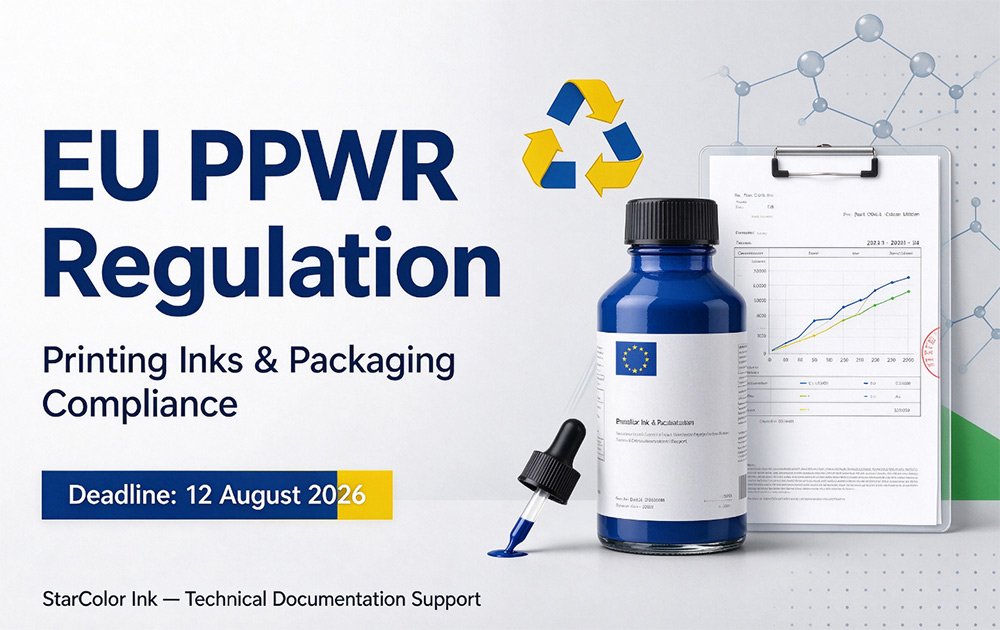
If you export printed packaging to the European Union, the new PPWR (Packaging and Packaging Waste Regulation, EU 2025/40) becomes legally binding on 12 August 2026. This regulation replaces the old 94/62/EC Packaging Directive and applies to all printed sales, secondary and transport packaging placed on the EU market. While PPWR targets finished packaging, printing inks are a critical component that can make or break your compliance. Printers, packaging converters and brand owners must complete a set of mandatory tasks before the deadline to avoid customs detention, product recalls and heavy fines.
What Is PPWR and How Does It Affect Printing Inks?
PPWR is a full lifecycle EU regulation focused on packaging circularity, restricted substances, traceability and waste management. A common misunderstanding: PPWR does not impose direct legal obligations on ink manufacturers to issue the PPWR Declaration of Conformity (DoC). The packaging producer/importer holds the main responsibility for the final packaging DoC.
However, ink suppliers like StarColor must provide complete technical documentation to support customers’ PPWR compliance work. Any restricted substances present in printing inks, varnishes or additives will be counted as part of the finished packaging assessment. This rule covers both water-based flexo/gravure inks and UV-LED curing inks used on paper, paperboard and flexible plastic packaging.
Two core substance rules kick in on 12 August 2026:
- Total heavy metals (lead, cadmium, mercury, hexavalent chromium) in finished packaging ≤100 mg/kg. Ink coatings are included in this test.
- PFAS limits for food-contact printed packaging: targeted PFAS ≤25 ppb; sum of targeted PFAS ≤250 ppb; total PFAS including polymeric PFAS ≤50 ppm. PFAS restrictions apply only to food contact packaging, but many packaging customers now request PFAS-free ink formulations for non-food applications as a proactive compliance measure.
StarColor supplies PFAS-free, low heavy-metal water-based inks and UV printing inks for EU packaging applications. We provide full test reports, REACH and food-contact supporting documentation to help converters build their PPWR technical files.
7 Mandatory Tasks To Complete Before 12 August 2026
Confirm whether your business acts as packaging producer, converter, importer or brand owner. Your legal duties differ by role. List all packaging SKUs exported to EU, separate food-contact packaging from non-food packaging, and record which printing inks and varnishes are used for each SKU. This step helps you identify high-risk lines requiring PFAS and heavy metal testing.
Contact your ink supplier to verify the formulation status: confirm no intentional PFAS additives (slip agents, levelling additives, matte varnishes are common PFAS sources), obtain heavy metal test reports for ink systems, collect REACH SVHC declarations, food contact statements for food packaging grades. Avoid last-minute surprises: many conventional inks contain trace PFAS or high heavy metals that will fail PPWR packaging testing.
Build a complete technical file for each packaging type. Required documents include: packaging material composition, printing ink and varnish material safety data sheets (MSDS), restricted substance test reports, recyclability and deinkability information for printed substrates, migration documentation for food-contact applications. As an ink manufacturer, StarColor can supply all ink-level supporting documents to complete your PPWR technical file.
Per PPWR Article 39, the packaging producer must issue a Declaration of Conformity (DoC) for each packaging variant before placing goods on the EU market from 12 August 2026. The DoC must be kept available for EU authorities upon request. Important note: StarColor does NOT issue the PPWR DoC for finished packaging, but our ink compliance certificates are essential evidence for your own DoC.
Extended Producer Responsibility (EPR) registration is mandatory for producers placing packaging onto EU markets. You must register in every member state where your packaged goods are sold and pay EPR fees. EPR registration deadlines vary by country; do not leave this task until August 2026.
PPWR introduces “design for recycling” principles. Printing ink should not damage the recyclability of the base substrate. For paper and paperboard packaging, deinkability becomes a key evaluation point. Poorly formulated UV or solvent inks may reduce recyclability ratings. StarColor water-based flexo inks are engineered for good deinkability for paper packaging.
Add PPWR compliance clauses with your ink suppliers, printers and converters. Clarify who is responsible for substance testing, documentation updates and traceability records. Build a process to update material certificates when ink formulations change.
Common PPWR Mistakes for Printing & Packaging Businesses
- Assuming ink suppliers are responsible for issuing the PPWR packaging DoC
- Ignoring PFAS risks in non-food packaging (customers may still require PFAS-free ink)
- Only testing substrates and excluding printed ink layers from heavy metal testing
- Delaying EPR registration until the August deadline
- Using old ink certificates without reviewing for PFAS or heavy metal limits
How StarColor Supports Your EU PPWR Compliance
StarColor is a professional manufacturer of water-based flexo/gravure inks and UV-LED printing inks for packaging. Our ink systems are developed for EU market compliance:
- PFAS-free ink options for food and non-food printed packaging
- Low heavy metal formulations meeting PPWR 100 mg/kg total heavy metal requirements
- REACH, FDA food contact supporting documents and test reports available
- Technical support for deinkability and recyclability assessment
- Custom ink formulation for flexible packaging, labels, paper and corrugated applications
We help packaging converters and brand owners collect all ink-related evidence required for PPWR technical files, reducing your compliance workload before the 12 August 2026 deadline.
Frequently Asked Questions
Does PPWR apply to printing ink itself?
No. PPWR regulates finished packaging, not printing ink as a standalone chemical product. However, ink components are assessed as part of the printed packaging. Non-compliant ink will cause the whole packaging batch to fail PPWR checks.
Do all packaging types need PFAS testing under PPWR?
No. The PPWR PFAS limits only apply to food-contact packaging from 12 August 2026. Non-food packaging does not have mandatory PFAS limits under PPWR Article 5(5). Still, many EU brands adopt PFAS-free ink as a proactive sustainability standard.
Are water-based inks automatically PPWR compliant?
No. Water-based ink is low-VOC, but compliance depends on its raw materials. A water-based ink may still contain high heavy metals or PFAS additives. Always request full test reports from your ink supplier.
What penalties apply for non-compliance after 12 August 2026?
Non-compliant printed packaging may be seized by EU customs, banned from sale, or subject to mandatory recall. Companies can face administrative fines depending on individual member state legislation.
Conclusion
The 12 August 2026 PPWR deadline is a critical milestone for any business selling printed packaging into the EU. Printing ink selection, substance testing, documentation and EPR registration are all time-intensive work. Start your PPWR audit and ink qualification early to avoid supply chain disruption.
Contact StarColor today to discuss PFAS-free, low heavy-metal water-based and UV printing inks for your EU packaging projects and obtain full compliance documentation.
Related products: water-based flexo inks | UV-LED printing inks