In the food packaging industry, "FDA" carries almost the weight of a seal of trust. When an ink is labeled "FDA-tested," what does it actually mean? A certificate to hang on a website — or a whole system that stands up to scrutiny? And now that the EU's PPWR is fully in force and the lamination era is ending, ink has gone from "protected by film" to "facing food directly." That is a change every food packaging company needs to understand. In this article, we unpack both questions.
1. First, let's be clear: what does "FDA testing" actually test?
The U.S. Food and Drug Administration (FDA) does not issue "certificates" for inks the way third-party certifiers do. Its approach is a regulatory system: under the Federal Food, Drug, and Cosmetic Act, any substance that may migrate into food is treated as an "indirect food additive," and its components must comply with the relevant provisions of Title 21 of the Code of Federal Regulations (21 CFR) — or obtain clearance through a Food Contact Notification (FCN) or a Threshold of Regulation (TOR) exemption.
For inks used in food paper packaging, the key regulations are:
- 21 CFR 175.300 — Resinous and polymeric coatings, commonly used to assess the printed ink film itself;
- 21 CFR 176.170 — Paper and paperboard in contact with aqueous and fatty foods; its quality assurance test limits total extractives to 0.5 mg/in²;
- 21 CFR 176.180 — Paper and paperboard in contact with dry foods;
- 21 CFR 178.3297 — Colorants for polymers, governing pigment safety.
On this basis, "FDA testing" typically covers five areas: composition compliance review (every resin, pigment and additive must have a traceable regulatory basis); total extractives / overall migration testing; specific migration testing (photoinitiators, primary aromatic amines, plasticizers, etc., with detection limits typically required at the 0.01 mg/kg level); heavy metals (lead, cadmium, mercury, hexavalent chromium); and sensory testing — the ink must not impart off-odor or off-color to food.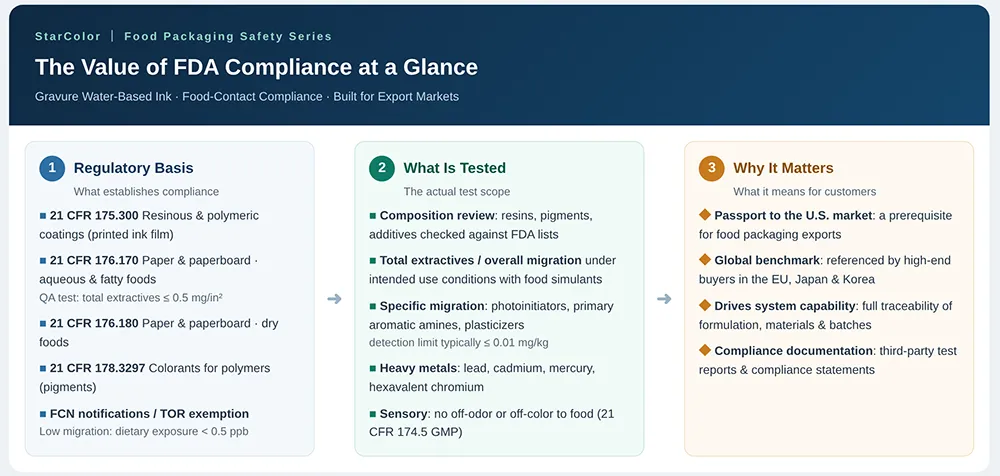
2. A new variable: the EU's PPWR brings the "lamination + reverse printing" era to an end
If the FDA is the threshold for market access, the EU's Packaging and Packaging Waste Regulation (PPWR, Regulation (EU) 2025/40) — now fully in force — is rewriting how food packaging is made.
PPWR entered into force on 11 February 2025 and has applied across the EU since 12 August 2026. Its core requirement can be summed up in one sentence: all packaging placed on the EU market must be recyclable — reaching recyclability grades A/B/C (≥70% recyclable) from 2030, and grades A/B (≥80%) from 2038. Meanwhile, single-use plastic grouped packaging (e.g., shrink wrap), plastic packaging for fresh fruit and vegetables, and single-use foodservice packaging for on-site consumption will be progressively banned; paper-based composite packaging containing 5% plastic or more is also subject to the plastic packaging restrictions.
For food paper packaging, this marks the end of the "gravure reverse printing + lamination" structure that dominated for decades: solvent-based ink printed on the inner side of a film, then laminated so the ink is "sandwiched" between layers, with the film isolating the ink from food. Because paper and plastic are difficult to separate, this structure is judged non-recyclable under PPWR's "design for recycling" principle — and EPR (extended producer responsibility) fees are modulated by recyclability grade, making lamination increasingly unaffordable.
PPWR also tightens substance requirements: the combined lead, cadmium, mercury and hexavalent chromium content of all packaging components must not exceed 100 mg/kg — ink, lamination and adhesives included, with no exemption. Strict limits are also set on PFAS in food-contact packaging.
In one sentence: the lamination era is over, and reverse printing has lost its stage. The new mainstream is single-material paper packaging with direct surface printing — the ink layer is no longer shielded by film but faces consumers and food directly. The era of relying on film to "cover" for the ink is gone; the ink itself must now be qualified: low migration, no benzene solvents, heavy metals within limits, no off-odor. This is the era of food-contact-grade ink.
3. Value #1: it is not "buying a certificate" — it is a hard test of formulation and systems
Plenty of inks can show an "environmental test report," but environmental compliance and food-contact compliance are two entirely different systems: environmental rules look at emissions, while food-contact rules look at migration — whether substances in the ink layer can "escape" into food during storage, heating, or contact with fatty foods. In the PPWR era the ink faces food directly, and this exam has moved from optional to mandatory.
To pass FDA-related testing consistently, every component in the formulation must fall within a regulation, an FCN, or a TOR exemption. Here is a detail many customers do not know: FCN clearance is "proprietary" — only the notifier and its customers may rely on it. So if an ink maker uses a raw material covered by someone else's FCN, it must establish a compliance relationship with the notifier — every link in the supply chain must stand up to scrutiny.
This is a real test of R&D capability, raw material control and batch consistency. At Star Color, our gravure water-based inks use water and alcohols as the solvent system, eliminating benzene solvents and high-migration-risk additives at the source. Every formulation component is checked against FDA compliance lists, and we maintain batch traceability from raw material intake to finished goods dispatch — so every batch can stand up to re-testing.
4. Value #2: a hard threshold for the U.S. market, a reference point worldwide
The FDA is the global benchmark for food-contact regulation. For food packaging exporters, delivering printed packaging to U.S. customers almost always requires the ink's FDA compliance statement and third-party migration test reports.
But the value goes far beyond the United States: high-end buyers in Europe, Japan, South Korea and even the Middle East routinely use FDA compliance as a key reference when evaluating suppliers. Now, with PPWR's recyclability requirements, exporting to the EU also runs through the ink. Global scrutiny of food packaging safety keeps tightening: the U.S. has progressively removed fluorinated substances (PFAS) used for grease-proofing paper from food-contact use, and China's national standard for inks for food-contact materials (GB 4806.14-2023) took effect in September 2024. Building compliance into the product early is not a cost — it is the ticket to premium markets.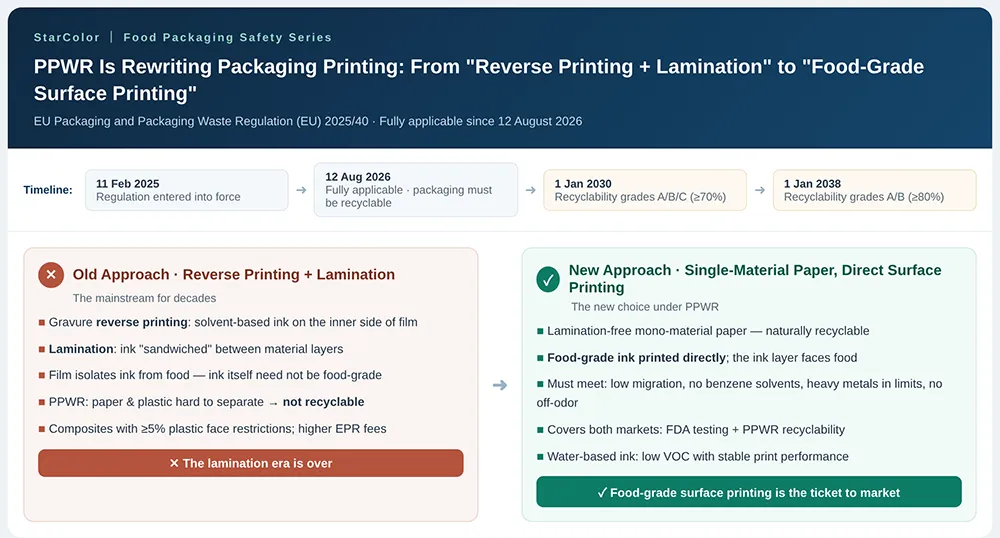
5. What this means for you
Choosing StarColor's FDA-tested, PPWR-aligned gravure water-based ink gives you more than a piece of paper — it is a verifiable guarantee:
- One ink covering both major markets: U.S. FDA + EU PPWR compliance;
- Direct surface printing on single-material paper, no lamination — keeping you on the "recyclable" path;
- Third-party migration test reports and compliance statements available with every delivery;
- Stable printing performance on napkins, paper cups, fry boxes and pizza boxes;
- A fully traceable quality-control system that brands can verify.
There is no shortcut in food safety — compliance is the best marketing. With lamination off the stage and both the FDA and PPWR focused on the ink layer, a truly food-contact-grade gravure water-based ink is your ticket into the U.S. and EU markets.