Many flexo printing plants often encounter color difference between front and back of the same batch, color shift when changing rolls, and color deviation after machine restart, resulting in ΔE>2, customer returns and rework. Especially for flexo water-based inks, due to water and additives in the system, viscosity, pH value and ink layer drying state fluctuate more easily compared with solvent-based inks. To stably control ΔE<2, full-process management covering ink control, printing parameters, plates, environment and inspection system is required. This article systematically breaks down practical methods for stable color performance.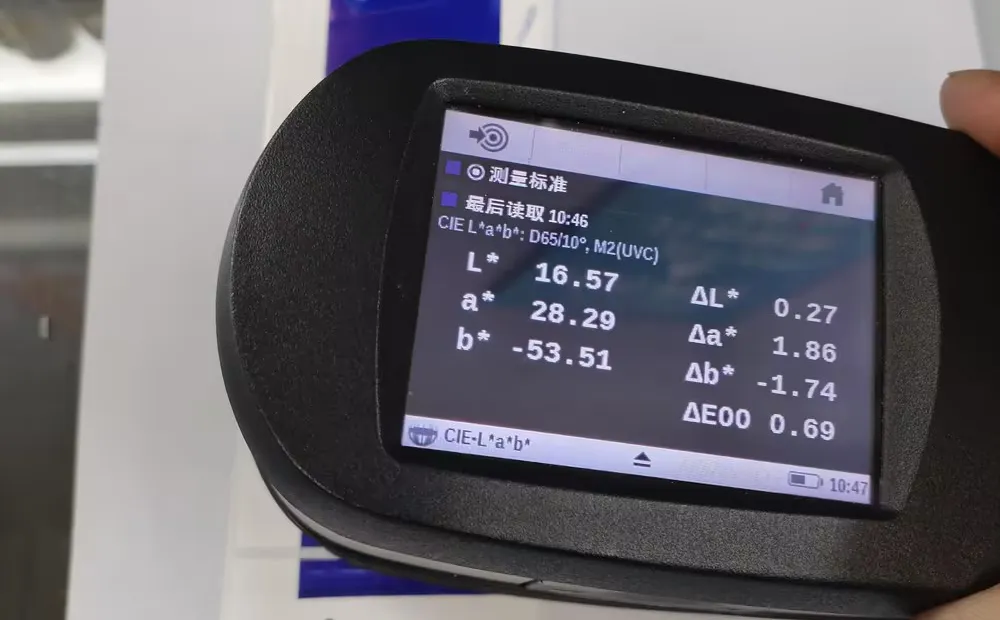
1. Control Standard for ΔE<2
Industry adopts CIE DE76 color difference. The smaller ΔE value, the closer the color match.
- ΔE>3: Visible to naked eyes, generally unacceptable for end customers;
- ΔE 2~3: Detectable under close observation, premium food packaging customers will raise objections;
- ΔE<2: Hardly distinguishable visually, high-quality flexo printing standard, widely adopted acceptance threshold for food paper cups and export flexible packaging orders.
2. Ink System Management
pH value and viscosity of water-based ink directly affect color concentration, which is the primary source of color fluctuation.
pH Stabilization
Water-based ink relies on ammonia additives to maintain dispersion. During printing, water and ammonia continuously volatilize, pH decreases, ink thickens, pigment particles aggregate and color deepens.
Recommended pH range: 8.2~9.2;
Operation: Test pH every 30 minutes, fine-tune with matched alkali regulator, avoid large one-time addition;
Warning: Do not add water randomly to adjust viscosity. Water dilution reduces pigment concentration and directly lightens color.
Viscosity Control
Viscosity variation changes ink volume transferred by anilox roller. Higher ink transfer leads to darker color, lower transfer causes lighter shade.
Before startup: Fully stir and test ink viscosity;
During production: Monitor viscosity with #4 cup every 30 minutes and keep stable;
Ink supply system: Circulate and stir ink barrel to prevent pigment sediment. After long pause, fully stir before restart to avoid high pigment concentration at the bottom.
Ink Batch Management
Do not directly mix old and new ink batches on press. Before new batch startup, make proofing against standard color sample and confirm ΔE<2 before mass production. When switching batches, clean ink path and anilox roller to avoid color difference caused by mixed inks.
3. Plate Material and Printing Pressure Control
Dot gain directly affects print color depth. The core rule of flexography is light kiss impression.
Printing plate: Use plates from the same batch for one order. Worn plates lead to dot loss and lighter prints; water-swollen plates create dot gain and darker color. Inspect plate integrity before mounting.
Printing pressure: Lock pressure parameters once first article color approval passes. Strictly restore settings during mass production, roll change and machine restart, random adjustment is forbidden. Excessive pressure causes dot gain and darker color; insufficient pressure results in incomplete dots and lighter prints.
Plate mounting & equipment: Use uniform mounting tape without bubbles to prevent local pressure difference and uneven color on plate. Regularly inspect impression roller runout and bearing wear to avoid periodic alternating deep-shallow color defects.
4. Drying, Workshop Temperature & Humidity Control
Water-based ink forms film via water evaporation, drying conditions directly determine final color appearance.
Drying control: Stabilize temperature, air volume and exhaust air. Insufficient drying leaves residual moisture, causing hazy and lighter ink layer. Excessively high temperature creates quick surface skinning (false dry), pigment migration and hue shift. Lock parameters after confirmation, no arbitrary changes allowed.
Workshop temperature & humidity: Recommended 22~28℃, relative humidity 50%-65%. High humidity slows water evaporation; low humidity makes ink dry prematurely on anilox roller and plates, blocking cells and reducing ink transfer volume, leading to lighter color. Adjust environment during rainy season and large morning-evening temperature swings.
Color measurement rule: All color matching and spectrophotometer testing must be performed on fully cooled and dried prints. Wet ink samples are not valid for reference.
5. Quick Troubleshooting of Common Color Difference Issues
- Gradually darkening color: Dropping ink pH, increased viscosity, pigment sedimentation;
- Gradually lightening color: Excessive water addition, clogged anilox roller, over-high drying temperature;
- Intermittent color difference: Poor ink circulation, doctor blade vibration, sharp fluctuation of workshop temperature and humidity;
- Color difference after roll change: Substrate batch variation, printing pressure drift.
Summary
To stably maintain ΔE<2 for flexo water-based ink printing, the solution is not adjusting single parameter, but standardizing the whole workflow: ink pH/viscosity, anilox ink transfer, printing pressure, drying, workshop environment and spectrophotometric color inspection. Water-based ink is sensitive to working conditions. Stable process control ensures consistent color, meeting high standards of food packaging and export orders.