Introduction
For packaging printers, converters and brand owners exporting food packaging into the European Union, PFAS control has moved from a voluntary sustainability target to a hard legal requirement. The EU Packaging and Packaging Waste Regulation (PPWR, EU 2025/40) entered into force on 11 February 2025, and its chemical requirements — strict PFAS and heavy metal limits — have applied to packaging placed on the EU market since 12 August 2026.
Printing inks, varnishes, slip additives and processing aids are critical control points. Many teams underestimate risk: PFAS may enter ink formulations not only through intentional fluorinated surfactants or levelling agents, but also as trace impurities in raw materials. Even low-level contamination can trigger non-compliance, border detention, product recalls and costly brand damage.
This complete guide breaks down PPWR PFAS rules, heavy metal requirements, testing protocols, documentation obligations, and practical steps to qualify PFAS-free printing inks for food packaging.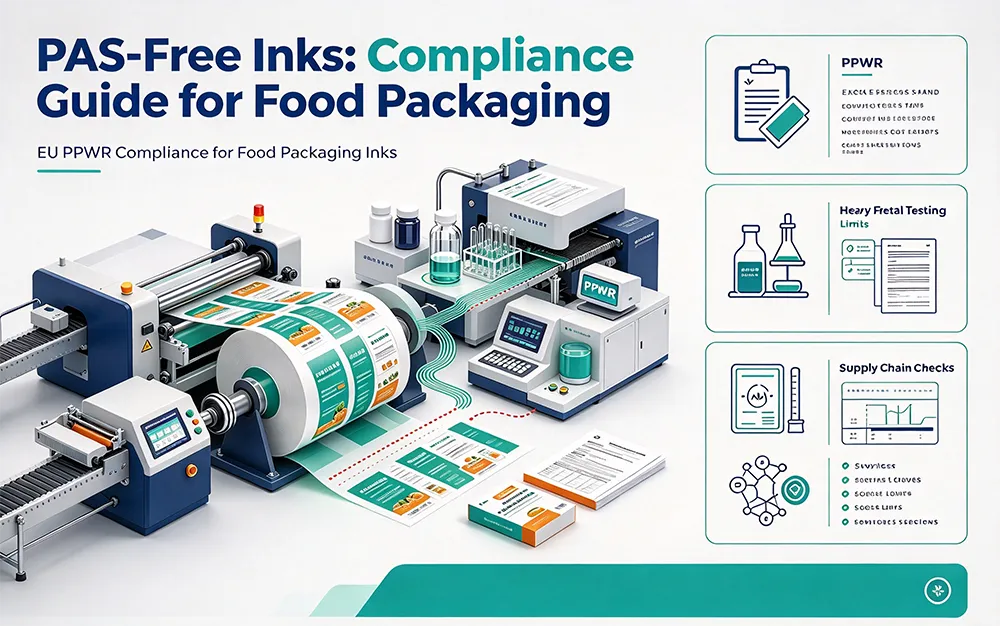
What Are PFAS and Why Are They Restricted in Food Packaging?
Per- and polyfluoroalkyl substances (PFAS), often known as "forever chemicals", are a large family of fluorinated compounds characterised by extreme environmental persistence and bioaccumulation. Historically, fluorinated additives were added to printing inks and coatings to improve slip, levelling, anti-blocking and grease resistance.
Under PPWR Article 5(5), food-contact packaging may not be placed on the EU market if PFAS concentrations exceed defined thresholds. The rules apply to direct and indirect food-contact packaging: paper cups, folding cartons, pizza boxes, fry boxes, paper wraps, fibre trays and flexible food packaging.
PPWR PFAS Limit Framework for Food Packaging
- Individual non-polymeric PFAS: ≤ 25 ppb
- Sum of targeted non-polymeric PFAS: ≤ 250 ppb
- Total fluorine (including polymeric PFAS): ≤ 50 ppm
It is critical to understand: PFAS-free does not simply mean "no intentional addition". Even trace carry-over impurities from resins, pigments or additives can breach the thresholds, requiring robust raw material screening and third-party analytical verification.
Note also that there is no transition period for existing stock: packaging already placed on the EU market before 12 August 2026 may continue to circulate, but any food-contact packaging first placed on the market after that date must comply — including packaging manufactured before the deadline.
PPWR Heavy Metal Requirement: 100 mg/kg Sum Limit
Alongside PFAS controls, PPWR mandates a total heavy metal cap for packaging components: the combined content of lead (Pb), cadmium (Cd), mercury (Hg) and hexavalent chromium (Cr⁶⁺) must not exceed 100 mg/kg in each packaging component.
For printing ink manufacturers and converters, this means:
- Inks and coatings must be tested separately as independent packaging layers; combined substrate+ink testing is not accepted.
- Raw material qualification must include heavy metal screening for pigments, binders and extenders.
- Test reports and supplier declarations must be retained for supply chain traceability.
What Is a True PFAS-Free Printing Ink for Food Packaging?
A compliant PFAS-free food packaging ink must satisfy two core conditions:
- No intentional addition of any PFAS in formulation design. All fluorinated surfactants, fluorinated slip agents and fluorine-containing levelling additives are eliminated from the recipe at R&D stage.
- Trace contamination controlled below PPWR analytical thresholds, verified via third-party laboratory testing.
EuPIA guidance confirms that a supplier declaration confirming no intentional PFAS use is an important document, but for food-contact packaging exporters, analytical testing is strongly recommended to demonstrate compliance and defend against market surveillance checks.
StarColor PFAS-free water-based flexographic inks are formulated with fluorine-free resin systems, with no intentionally added PFAS. Third-party LC-MS/MS PFAS screening and total fluorine testing confirm values far below PPWR limits, alongside heavy metal results under the 100 mg/kg total threshold. Our ink portfolio is designed for paper cups, takeaway cartons, napkins, corrugated food boxes and fibre-based packaging for EU export.
Supply Chain Compliance Checklist for Printers & Brand Owners
1. Audit your ink and additive suppliers
Request from your ink vendor:
- PFAS-free declaration of formulation (no intentional PFAS addition)
- Full third-party PFAS test report (targeted PFAS panel + total fluorine)
- PPWR heavy metal test report (Pb, Cd, Hg, Cr⁶⁺ sum ≤100 mg/kg)
- Food contact compliance statements (FDA 21 CFR 175.300, EU 10/2011 as applicable)
- Raw material screening records for resins, pigments and additives
Common hidden PFAS risk points: matte varnishes, anti-set-off powders, slip additives and wax emulsions. These are often overlooked but fall under PPWR scope.
2. Test finished packaging, not only ink
PPWR applies to the final food-contact packaging article. Even if your ink is PFAS-free, fluorine-containing substrate coatings can cause the finished packaging to fail. Printers must audit board suppliers, greaseproof treatments and laminating adhesives as part of the full compliance package.
3. Maintain full traceability and documentation
Supply chain records must be archived and available for inspection:
- Batch certificates for every ink shipment
- Declaration of compliance (DoC) for packaging articles
- Test reports, supplier audit records and material substitution logs
- Change control documentation whenever ink formulations or raw material sources are modified
4. Validate printing process risks
Process contamination is another hidden risk. When switching to PFAS-free inks, thoroughly clean press tanks, pumps, anilox rolls and supply lines. Residual fluorinated inks from old jobs can contaminate new PFAS-free batches and cause test failures.
PFAS-Free Ink Performance Considerations
Many converters worry that removing fluorinated additives will degrade print performance. Modern water-based PFAS-free ink systems are engineered to replace fluorinated additives with non-fluorine alternatives to maintain key properties:
- Anti-blocking and slip performance
- Good wetting and levelling on recycled paper and board
- Fast drying for high-speed flexo presses
- Strong colour strength and print sharpness
- Low migration for dry and fatty food contact applications
StarColor PFAS-free water-based flexo inks are optimised for high-speed flexo printing (150–400 m/min) on kraft board, recycled fibre, coated paper and paper cup stock, balancing regulatory compliance with production efficiency.
Frequently Asked Questions
Q1: Can I rely only on a "no intentional PFAS added" letter for PPWR compliance?
A: Supplier declarations are useful evidence, but EU market surveillance authorities may request analytical test results to verify trace PFAS levels. For export to EU food packaging markets, combining a declaration with third-party PFAS testing is best practice.
Q2: Does PPWR PFAS rule apply to printed outer packaging that is not in direct contact with food?
A: PPWR Article 5(5) scope targets food-contact packaging. If the printed layer forms part of the food-contact side or the packaging structure may transfer substances to food, the PFAS limits still apply. Brand owners should define contact boundaries clearly in material specifications.
Q3: Are UV inks also required to meet the same PFAS thresholds?
A: Yes. All printing inks, varnishes and coatings used on food-contact packaging fall under PPWR PFAS rules, regardless of drying technology (water-based, UV, solvent).
Q4: What happens if packaging fails PPWR PFAS inspection?
A: Non-compliant goods can be detained at EU borders, withdrawn from the market, recalled, and subject to fines. Brand owners and importers carry significant legal responsibility, not only printers or ink suppliers.
Conclusion
PPWR has transformed food packaging compliance, placing PFAS and heavy metal controls at the centre of packaging design and ink selection. PFAS-free printing ink is no longer a premium sustainability option — it is a market access requirement for EU food packaging exports.
Successful compliance relies on three pillars: selecting inherently PFAS-free ink formulations, auditing every component across the full supply chain, and maintaining complete test documentation and traceability.
StarColor provides PFAS-free, PPWR-ready water-based flexo printing inks with full test documentation for food packaging. Our technical team supports printers and brand owners with formulation selection, sample testing and compliance file preparation for EU market entry.
Ready to switch to PFAS-free food packaging inks? Contact us for technical data sheets, test reports and free ink samples.