Accurate ink consumption estimation has long been a challenge for printing companies. Whether for quotation, cost control, raw material planning, or production scheduling, precise calculation of water-based ink usage is essential.
Many companies still rely on experience-based estimation, which often leads to overstocking or urgent replenishment during production. Especially in new project planning and batch production, a scientific and standardized calculation method is critical for cost control and efficient management.
Ink consumption in flexographic printing is not a fixed value. It is influenced by multiple factors such as substrate properties, anilox roller parameters (LPI & BCM), printing speed, image coverage, order size, and production losses.
1. Core Concepts and Industry Conversion Standards
All calculations in this guide are based on ready-to-use water-based ink (no dilution adjustment required).
1.1 Anilox Roller Key Parameter
- BCM Definition: The theoretical ink volume per square inch of the anilox roller (billion cubic microns/in²)
- Industry Conversion: 1 BCM ≈ 1.55 cm³/m²
- Ink Density: 1 cm³ ≈ 1.0 g
- Final Conversion: 1 BCM ≈ 1.55 g/m² (theoretical ink transfer)
1.2 Key Calculation Factors
- Effective Ink Transfer Rate: Percentage of ink transferred from anilox to substrate
- Print Coverage: Percentage of printed area
- Substrate Correction Factor: Based on absorption and surface energy
- Speed Loss Factor: Ink loss caused by printing speed
- Total Production Loss Factor: Includes setup, cleaning, waste, and leftovers
2. Standard Calculation Formula
2.1 Ink Consumption per Unit Area (g/m²)
Ink Consumption = BCM × 1.55 × Transfer Rate × Substrate Factor × Speed Factor × Coverage
2.2 Total Ink Consumption per Order (kg)
Total Ink = Total Printing Area (m²) × Ink Consumption (g/m²) × Loss Factor ÷ 1000
3. Industry Standard Parameter Values
3.1 Anilox LPI vs BCM (Water-Based Flexo)
| Application | LPI | BCM | Description |
|---|---|---|---|
| Solid areas / nonwoven / heavy ink | 180–250 | 8.0–12.0 | High opacity, thick ink layer |
| General printing | 300–350 | 5.0–7.0 | Balanced performance |
| Fine details / labels | 400–500 | 2.5–4.0 | Thin ink layer, high precision |
Rule: Lower LPI → higher BCM → higher ink consumption.
---3.2 Substrate Correction Factors
| Substrate | Factor | Characteristics |
|---|---|---|
| BOPP / PET / PE film | 1.00–1.05 | Non-absorbent, stable consumption |
| Coated paper | 1.10–1.15 | Light absorption |
| Kraft paper | 1.20–1.30 | Medium absorption |
| Nonwoven | 1.35–1.50 | High porosity, high ink usage |
| Corrugated board | 1.30–1.40 | Rough and highly absorbent |
3.3 Speed Loss Factor
| Speed (m/min) | Factor |
|---|---|
| ≤80 | 1.00 |
| 80–150 | 1.05–1.10 |
| 150–250 | 1.10–1.20 |
3.4 Ink Transfer Rate
- Closed doctor blade system: 40%–50% (recommended 45%)
- Open system: 30%–40%
3.5 Production Loss Factor
| Order Size | Factor |
|---|---|
| <50,000 m² | 1.15–1.25 |
| 50,000–200,000 m² | 1.08–1.12 |
| >200,000 m² | 1.03–1.06 |
4. Practical Calculation Example
Given Conditions
- Substrate: Nonwoven (factor 1.40)
- Speed: 180 m/min (factor 1.15)
- Anilox: 250 LPI, BCM = 10.0
- Transfer rate: 45%
- Coverage: 35%
- Total area: 8000 m²
- Loss factor: 1.10
Step 1: Ink Consumption per m²
10.0 × 1.55 × 0.45 × 1.40 × 1.15 × 0.35 = 3.53 g/m²
Step 2: Total Ink Consumption
(8000 × 3.53 × 1.10) ÷ 1000 = 31.06 kg
Conclusion: The total required ink for this job is approximately 31.06 kg, which can be directly used for procurement and cost estimation.
Conclusion
Accurate ink consumption calculation is essential for cost control, quotation accuracy, and production efficiency. By applying standardized formulas and industry parameters, printers can replace guesswork with data-driven decision making.
This method enables:
- Precise cost estimation
- Optimized inventory planning
- Reduced waste and downtime
- Improved production management
Calculate Your Ink Consumption Instantly
While the formulas and parameters above provide a reliable method for estimating water-based flexo ink consumption, real production conditions can vary significantly.
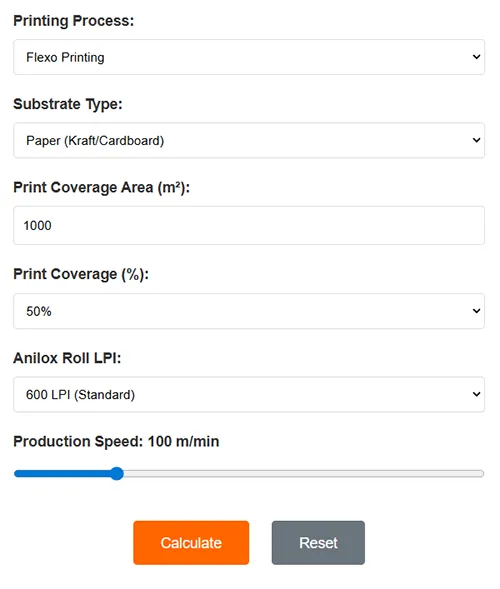
To simplify your workflow and improve accuracy, you can use our online ink consumption calculator to get instant results based on your actual printing parameters.
Try the Flexo Ink Consumption Calculator Now
This tool helps you:
- Quickly estimate ink usage for new orders
- Improve quotation accuracy
- Optimize raw material planning
- Reduce waste and production costs
For converters and printing factories, accurate ink estimation is not just a calculation—it is a competitive advantage.