RU
RU EN
EN CN
CN


Metallic gold printing is widely used in premium packaging such as food packaging, cosmetics, and gift products because it delivers strong visual impact and a high-end appearance. However, printing gold using water-based gravure ink is technically more demanding than printing standard colors.
The difficulty mainly lies in maintaining metallic gloss, ensuring stable ink performance, and achieving reliable adhesion during high-speed gravure printing. Without proper control, issues such as uneven gloss, oxidation discoloration, poor adhesion, and incomplete drying may occur.
This article explains the major technical challenges and practical solutions for printing metallic gold using water-based gravure inks, helping printers achieve stable and high-quality production.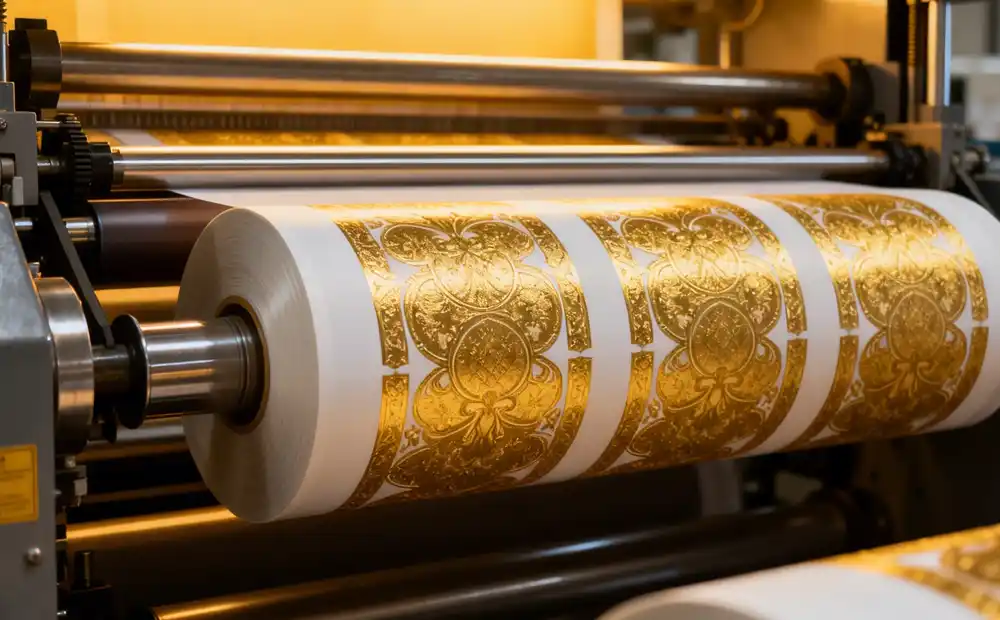
Key Characteristics of Gold Gravure Ink
Unlike conventional inks that use organic or inorganic pigments, gold inks rely on metallic pigments—typically copper-zinc alloy powder—to produce their reflective appearance. These flake-shaped particles must remain uniformly dispersed in the ink film to create a smooth metallic effect.
In water-based systems, the combination of high-density metallic particles and water as the dispersion medium introduces additional challenges in dispersion stability, film formation, and oxidation resistance.
To achieve consistent printing quality, gold inks must maintain:
- Uniform metallic pigment dispersion
- Dense and stable ink film formation
- Resistance to oxidation and discoloration
- Compatibility with high-speed gravure printing processes
Main Printing Challenges and Solutions
1. Metallic Pigment Dispersion Instability
Uneven pigment dispersion can cause color variation, mottled appearance, or particle agglomeration on the printed surface. In severe cases, pigment clusters may damage the doctor blade or block gravure cells.
Key causes:
- High density of metallic pigments leading to sedimentation
- High surface tension of water limiting pigment wetting
- Improper ink mixing or insufficient dispersants
- Inadequate ink circulation during printing
Practical solutions:
- Mix the ink gently at low speed (300–500 rpm) for 15–20 minutes before use.
- Filter the ink through a 200-mesh screen to remove large particles.
- Maintain viscosity at approximately 25–30 seconds (DIN #4 cup, 25°C).
- Use continuous ink circulation in the ink tray to prevent sedimentation.
- Regularly clean gravure cylinders and doctor blades.
2. Insufficient Drying
Water-based inks dry more slowly than solvent-based systems because water has a higher evaporation energy. Metallic pigments can further slow moisture release, causing tackiness, blocking during rewinding, and reduced gloss.
Recommended process parameters:
- Multi-stage drying system with hot air circulation
- Initial drying temperature: 50–60°C
- Final drying temperature: 65–75°C
- Air speed: 4–6 m/s
- Drying tunnel length: at least 2.5 m
For high-speed printing above 200 m/min, infrared drying assistance may improve moisture evaporation and prevent blocking during rewinding.
3. Oxidation and Loss of Metallic Gloss
Gold pigments composed of copper-zinc alloy are chemically sensitive and may oxidize when exposed to moisture, oxygen, or acidic substances. Oxidation can cause the color to darken or shift toward reddish or brown tones.
Prevention strategies:
- Use oxidation-resistant gold inks containing protective additives.
- Store ink in sealed containers in dry and cool conditions.
- Apply protective coatings such as water-based varnish or lamination when required.
- Maintain controlled humidity in the printing environment.
4. Poor Adhesion and Registration Accuracy
Metallic pigments can reduce the bonding strength between ink and substrate, especially on non-porous materials such as PET or PP films. This may result in poor adhesion or registration deviation during multi-color printing.
Recommended solutions:
- Perform corona treatment to increase surface tension to 38–42 mN/m.
- Add manufacturer-recommended adhesion promoters.
- Maintain stable printing speed between 80–150 m/min.
- Use the printing sequence: process colors first, gold last.
Production Control Best Practices
Achieving stable gold printing requires control across the entire production process:
- Proper ink storage and batch management
- Standardized ink mixing procedures
- Regular equipment maintenance and calibration
- Controlled temperature and humidity in the printing room
- Post-printing curing and quality inspection
By implementing consistent process control, printers can significantly reduce defects and improve production efficiency.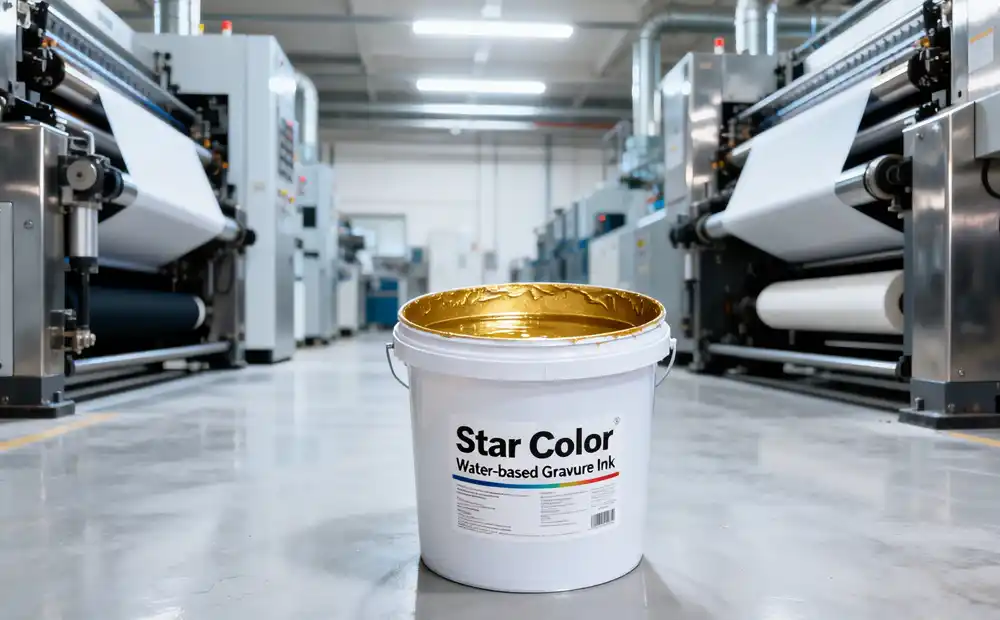
Recommended Product: StarColor Water-Based Gold Gravure Ink
StarColor water-based gold gravure ink is specially developed to address the technical challenges of metallic printing. The formulation combines high-purity coated copper-zinc pigments with modified water-based acrylic resins and advanced dispersants to ensure stable performance.
Key advantages include:
- Excellent pigment dispersion and sedimentation resistance
- Bright metallic gloss with customizable gold shades
- Fast drying suitable for printing speeds up to 150 m/min
- Strong adhesion on paper, PET, and PP substrates
- Low-VOC formulation compliant with environmental standards
The ink integrates easily with existing gravure printing equipment without requiring major process changes, allowing printers to achieve high-quality metallic effects while maintaining efficient production.
Conclusion
Printing metallic gold using water-based gravure ink requires balancing pigment dispersion, oxidation resistance, drying efficiency, and adhesion performance. By selecting suitable inks and optimizing printing parameters, manufacturers can achieve consistent metallic effects while maintaining stable production.
With specialized formulations and technical support, StarColor water-based gold gravure inks help printers overcome these challenges and produce premium packaging with strong visual appeal.