1. Core Application Scenarios
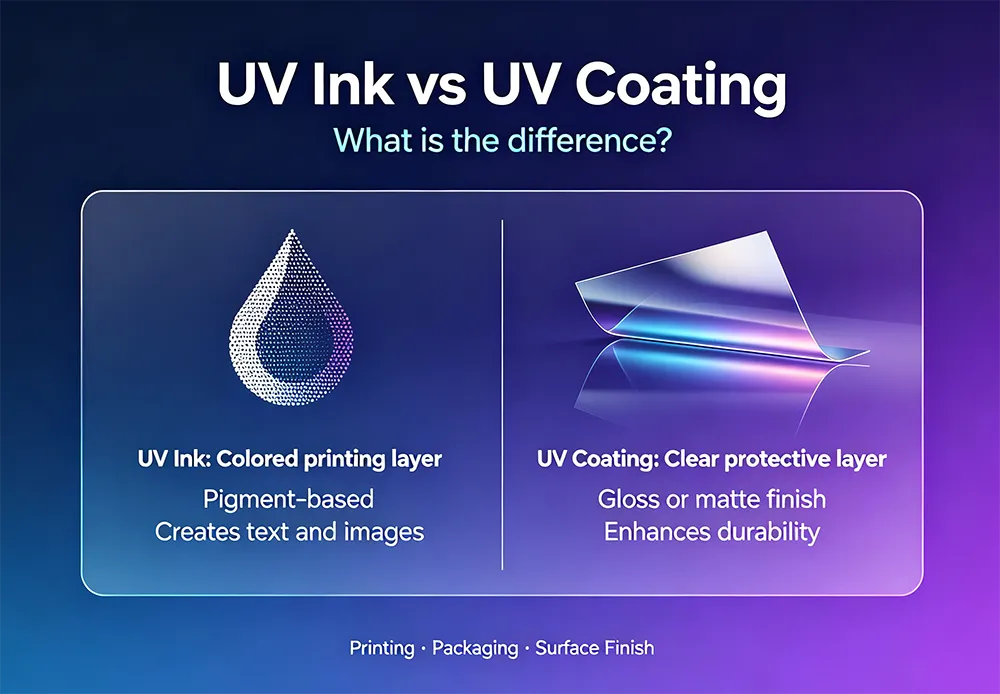
UV Ink is specially developed for graphic printing and pattern reproduction. It is widely used on paper, plastic films, BOPP, PET, PVC, aluminum foil and other printing substrates. Its main function is to present clear textures, accurate colors, text and logos. It is commonly applied in mid-to-high-end packaging, including cigarette packs, wine packaging, cosmetics, health products, food and pharmaceutical printing.UV Coating is an industrial surface protection and finishing material. It focuses on substrate protection, gloss enhancement and physical modification. It is commonly used for furniture, flooring, automotive parts, hardware, electronic products and large-area industrial surface finishing, replacing traditional solvent-based coatings for higher environmental performance and durability.
2. Functional & Performance Orientation
UV Ink — Focus on printing fidelity and color presentation- Ultra-fast UV curing to support high-speed printing lines
- High color saturation, strong tinting power, precise dot restoration and excellent pattern clarity
- Good printability, leveling and screen adaptability
- Cured ink layer features stable abrasion resistance, weather resistance and chemical resistance
- Low VOC formula, compliant with environmental and food-grade packaging standards
- Instant curing to greatly shorten industrial coating cycles
- High hardness, outstanding scratch resistance, wear resistance and flexibility
- Uniform gloss performance (matte, high-gloss, satin customizable)
- Excellent surface leveling, anti-fouling and anti-yellowing properties
- Low VOC and pollution-free, suitable for large-scale industrial finishing
3. Formula Composition Differences
UV ink and UV coating share the same basic UV-curing system framework, including oligomers, reactive diluents and photoinitiators. However, their design logic is completely different.UV Ink adds high-concentration color pigments and functional color additives. The formula is optimized for dispersion stability, color consistency, tinting strength and printing fluency. Film toughness and hardness are balanced to adapt to printing stretching and rolling.
UV Coating contains no or very few pigments. Its formula focuses on high hardness, fullness, scratch resistance and surface leveling. More functional auxiliaries are added to meet industrial protection requirements, resulting in a more complex and adjustable system than UV ink.
4. Construction & Production Process
UV Ink Printing Process UV ink is transferred to the substrate surface through professional printing equipment such as flexo, offset, gravure or screen machines. After pattern transfer, it is instantly cured by UV lamps to form a thin, precise, high-resolution color ink layer. The process is simple, efficient and suitable for high-precision graphic reproduction.UV Coating Construction Process UV coating requires complete surface pretreatment (degreasing, dedusting, smoothing). It can be applied via roller coating, spray coating or curtain coating. After coating, the product enters the UV curing system to form a thick, high-protection finish. The overall process is more systematic and industrialized than ink printing.
5. Comprehensive Comparison Table
| Comparison Item | UV Ink | UV Coating |
|---|---|---|
| Main Purpose | Graphic printing, color presentation, pattern reproduction | Surface protection, gloss finishing, physical reinforcement |
| Application Industry | Packaging printing, paper printing, plastic printing | Furniture, flooring, automotive, electronics, industrial finishing |
| Core Advantage | High definition, accurate color, stable printing performance | High hardness, scratch resistance, fullness, durability |
| Formula Feature | Pigment-containing, color-oriented formula | Clear or transparent, functional protective formula |
| Coating Thickness | Thin layer, precise and controllable | Thicker film, strong covering and protection |
| Construction Method | Printing machine transfer | Spraying, roller coating, curtain coating |
| Performance Focus | Color stability, dot reproduction, printability | Hardness, abrasion resistance, flatness, weather resistance |
| Environmental Performance | Low VOC, eco-friendly | Low VOC, zero pollution, industrial green grade |