Driven by green printing concepts and high-efficiency production demands, UV ink is gradually replacing traditional solvent-based and water-based ink, becoming the mainstream material for labels, food packaging and high-end printing. Different from the drawbacks of high pollution, high energy consumption and low productivity of conventional ink, UV ink features zero VOC emission, instant curing, low power consumption, wide substrate compatibility and outstanding durability. Supported by actual test data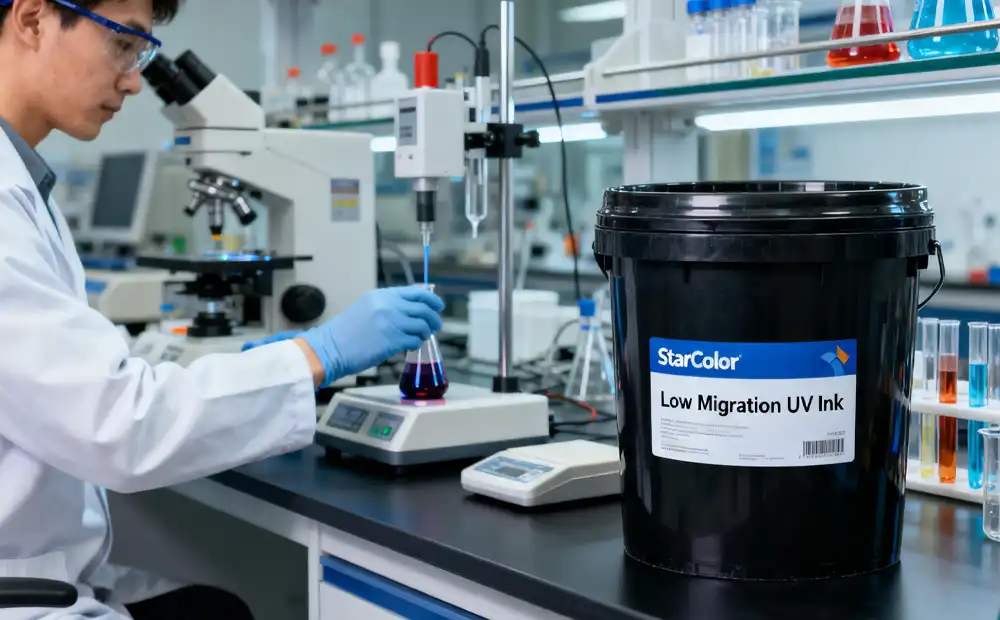
1. Environmental Performance: Zero VOC Emission, Over 40% Carbon Reduction
Traditional solvent-based ink contains 30%-70% volatile organic compounds. Around 30%-50% VOCs release during drying process, threatening worker health and requiring costly waste gas treatment. Adopting 100% solid solvent-free formula, UV ink generates nearly zero volatile substances, far below national and international emission limits, fully complying with global environmental regulations.
| Index | Traditional Solvent Ink | Average Industrial UV Ink | StarColor LED-UV Ink |
|---|---|---|---|
| VOC Content | 30%-70% | Below 5g/L | 0g/L Solvent-free Formula |
| Product Carbon Emission | 100% Benchmark | 30%-40% Reduction | 40%-50% Reduction |
| Environmental Compliance Cost | High | Low | Risk-free with Full Certifications |
StarColor Superiority: All UV ink products pass SGS and Intertek tests, conforming to REACH, FDA 21 CFR §175.300 and GB 4806 standards. Free from heavy metals and phthalates, the ink is safely applicable for food, pharmaceutical and infant product packaging without compliance risks.
2. Production Efficiency: Instant Curing, Over 85% Productivity Improvement
Conventional ink relies on slow evaporation to dry, spending 3-10 minutes for solvent ink and 5-20 minutes for water-based ink. The maximum running speed is only 80-150m/min with large space reserved for semi-finished goods. UV ink completes photopolymerization within 0.1-3 seconds, realizing printing and drying simultaneously. The production speed reaches 300-600m/min, greatly shortening manufacturing cycle and eliminating stacking problems.
| Index | Traditional Solvent Ink | Average Industrial UV Ink | StarColor LED-UV Ink |
|---|---|---|---|
| Curing Time | 3-10 minutes | 0.1-3 seconds | 1-2 seconds Low-temperature Curing |
| Max Printing Speed | 80-150m/min | 300-400m/min | 250-500m/min |
| Semi-product Storage Area | 100% Benchmark | 80% Reduction | 90% Reduction with Immediate Rewinding |
StarColor Superiority: Optimized photoinitiator and resin system achieves 92% crosslinking rate at high-speed printing, effectively avoiding stickiness and incomplete curing. Compared with traditional mercury lamp UV equipment, LED-UV technology cuts power consumption by 60%, saving 40,000 to 60,000 kWh electricity per machine annually.
3. Energy Consumption: Low-temperature Curing, Over 60% Energy Saving
Traditional drying requires high temperature ranging from 60℃ to 80℃, causing massive heat loss, substrate deformation and pigment discoloration. LED-UV ink cures at mild temperature of 25℃ to 50℃ without high heat source, reducing overall energy consumption by 50%-70% and supporting low-carbon manufacturing.
| Index | Traditional Solvent Ink | Average Industrial UV Ink | StarColor LED-UV Ink |
|---|---|---|---|
| Curing Temperature | 60-80℃ | 25-50℃ | 30-45℃ Precise Temperature Control |
| Energy Consumption Ratio | 100% Benchmark | 50%-60% Reduction | 60%-70% Reduction |
| Substrate Loss Rate | 3%-5% | Below 1% | Below 0.5% |
StarColor Superiority: Stable curing temperature prevents thermal damage on heat-sensitive PET and PE materials. Curing energy is precisely controlled between 800-1200mJ/cm² to balance curing effect and energy efficiency.
4. Substrate Compatibility: Strong Adhesion, 70% Less Ink Replacement Cost
Traditional ink has poor universality. Solvent ink easily peels off on non-absorbent film materials, while water-based ink tends to form pinholes and craters. Different substrates demand matched ink types, bringing frequent replacement and material waste. Cured UV ink forms dense film with excellent adhesion, compatible with paper, synthetic paper, PP, PE, PET and aluminum foil, fitting flexo, gravure and screen printing processes.
| Index | Traditional Solvent Ink | Average Industrial UV Ink | StarColor LED-UV Ink |
|---|---|---|---|
| Applicable Substrates | Limited to Paper | 80% Common Materials | Over 95% Full Material Compatibility |
| PE/PET Adhesion Grade | 1-2B | 3-4B | 4B Stable Adhesion |
| Ink Replacement Frequency | Frequent | Moderate | Rare Universal Application |
StarColor Superiority: Self-developed adhesion promoter realizes stable attachment on low surface tension films above 38dyn/cm, lowering corona treatment cost. One universal ink suits most label materials and cuts ink switching cost by 70%.
5. Printing Quality: High Abrasion Resistance, Doubled Service Life
Conventional ink film features loose structure with weak scratch resistance and fast fading. Residual solvent also causes substance migration which fails food safety standards. UV ink forms compact cross-linked structure with outstanding water, alcohol and aging resistance, presenting vivid color and high dot restoration rate with safe low-migration property.
| Index | Traditional Solvent Ink | Average Industrial UV Ink | StarColor LED-UV Ink |
|---|---|---|---|
| Abrasion Resistance Times | Less than 50 times | 150-200 times | More than 250 times |
| Outdoor Weather Resistance | 3-5 years | 8-10 years | 10-12 years |
| Dot Restoration Rate | 70%-80% | 85%-90% | 92%-98% |
| Migration Level | High | Low Food-grade Safe | Extremely Low Certified Safe |
StarColor Superiority: Fine particle size below 8μm ensures clear tiny text and lines. Tough ink film adapts to die-cutting, lamination and hot stamping processes. Food-grade series passes EU 10/2011 and FDA certification, fully safe for direct food contact packaging.
Conclusion
With comprehensive data advantages in environmental protection, productivity, energy saving, compatibility and printing quality, UV ink reshapes traditional printing mode and becomes the preferred choice for green and efficient production. As a professional manufacturer, Huizhou StarColor UV Ink breaks industrial limitations via technological innovation, delivering integrated solutions covering compliance, high output, stable quality and cost reduction.
Against tightening global environmental policies and industrial upgrading trends, StarColor will keep optimizing ink performance, assisting printing enterprises in low-carbon transformation and value growth, and promoting Chinese UV ink products to compete in the global high-end market.