In the flexographic UV printing system for PETG heat shrink films, cracking and pattern edge chipping during post-shrinking processing have long been prevalent technical pain points. Unlike defects generated on ordinary paper and flat plastic films, this type of failure does not show visible abnormalities immediately after printing, and only emerges under the coupling effect of mechanical deformation and thermal stress. This paper deeply dissects the essential root causes of UV ink cracking on PETG shrink films from four core technical dimensions: polymer material characteristics, UV curing reaction mechanism, interfacial bonding force and mechanical stress conduction, and accurately reveals hidden technical defects arising from mass production.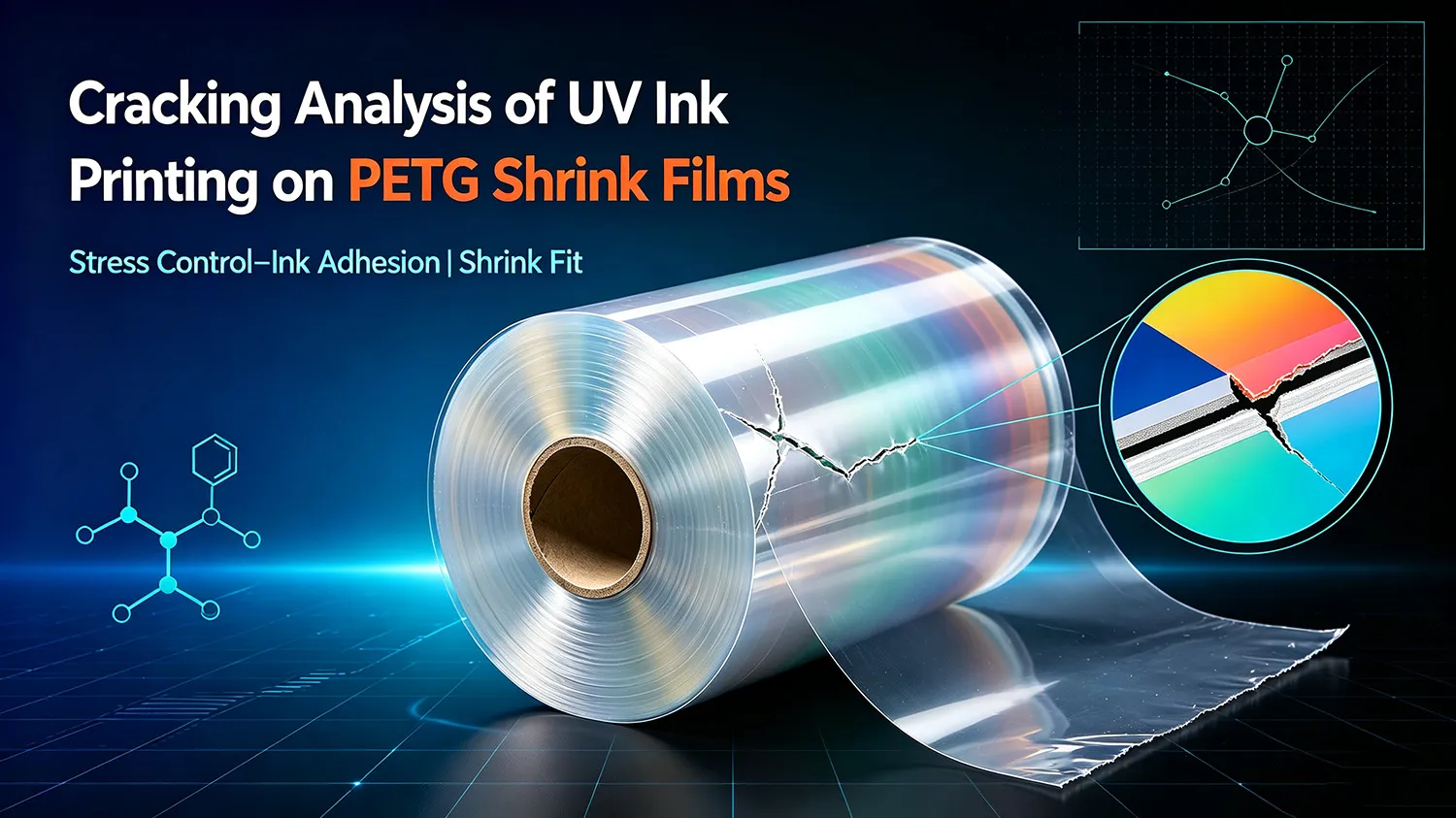
1. Mismatched Molecular Structure of Resin System
PETG belongs to copolyester materials. Distinct from common homopolymer PET, its molecular chain is modified with cyclohexanedimethanol, forming a high proportion of amorphous regions. Macroscopically, PETG features high elasticity and high shrinkage rate; its molecular chains can contract rapidly upon heating, with a maximum deformation rate exceeding 50%. Conventional UV flexo inks generally adopt pure acrylic resin and high-functionality polyurethane acrylate resin systems, which are formulated to prioritize high abrasion resistance, scratch resistance and surface hardness.
In terms of molecular structure, cured conventional UV resins form dense three-dimensional crosslink networks with rigid, fixed-length molecular segments that barely slide. Macroscopically, such cured films exhibit high elastic modulus and low elongation at break, presenting obvious brittleness. This system fits rigid substrates without deformation, yet cannot adapt to the dynamic deformation characteristics of PETG. When PETG shrinks under heat, its molecular chains undergo axial contraction and radial stretching for continuous deformation. However, the crosslink network of cured ink film fails to slide or extend synchronously, so deformation stress cannot be released via molecular chain relaxation. Eventually, the crosslink structure of the ink film is torn, producing regular cracks and edge chipping. This material compatibility mismatch serves as the fundamental cause of UV ink cracking on shrink films, rather than improper operational processes.
2. Internal Stress Accumulation Triggered by Over-Curing
The crosslinking degree of cured UV ink directly determines the toughness and internal stress of ink film, and the curing reaction has an optimal crosslink interval and an over-crosslink critical threshold. To avoid surface tackiness and insufficient abrasion resistance during mass production, printing plants commonly deploy high-power UV lamps, repeated secondary curing and fast line speed intensive curing modes, leading to excessive functional group reactions and crosslink density far exceeding the designed threshold.
From the perspective of reaction mechanism: over-curing causes excessive entanglement of resin molecular chains and dense accumulation of crosslink points, completely eliminating the sliding space for elastic molecular chains and drastically reducing elongation at break. Meanwhile, rapid photocuring forces molecular chains to bond under unstable states, generating irreversible volume shrinkage stress and interfacial residual stress inside the ink film.
Under normal temperature without deformation, residual stress remains in latent equilibrium with no obvious defects. When PETG shrinks under heating, the temperature field breaks stress balance, and accumulated internal stress superimposes with external deformation force to drastically lower the brittleness threshold of ink film. Slight deformation will break the crosslink network and produce uniform fine cracks. Furthermore, over-curing destroys flexible anchor points at the interface between ink and PETG, transforming flexible interfacial adhesion into rigid hard bonding and completely eliminating deformation tolerance.
3. Interfacial Wetting and Anchoring Defects
To guarantee extreme shrinkage performance, no toughening or adhesion-promoting additives are incorporated during PETG shrink film production. Its surface features compact molecular structure, low surface energy and strong chemical inertness, making it a typical hard-to-print substrate. Conventional corona treatment only achieves micro-roughening on the film surface without changing the inherent inert property of the substrate. Besides, precise control of corona power is difficult, easily causing two technical defects: insufficient treatment and excessive treatment.
With insufficient treatment, UV ink cannot fully wet and spread on PETG surface, and resin molecules fail to penetrate micro-pores on the substrate surface, only forming superficial virtual adhesion instead of molecular-level anchoring, resulting in uneven interfacial bonding force. During shrinkage deformation, regions with weak adhesion cannot transmit or disperse stress, acting as stress concentration points where microcracks first generate and rapidly expand and connect.
With excessive treatment, strong ionization breaks molecular chains on the top layer of PETG, destroying the amorphous flexible structure of the substrate surface and embrittling the film surface. The reduced deformation toughness of the base film triggers composite cracking where substrate microcracks drive ink layer cracking, significantly raising defective rates.
4. Abnormal Ink Film Thickness Gradient
Excessive ink load and overly thick ink film in flexographic printing act as hidden key technological factors inducing cracking, whose core mechanism lies in mismatched ink thickness and curing gradient plus layered stress accumulation. UV photocuring has limited penetration; thick ink films form distinct curing gradients: the top layer directly exposed to UV light gains sufficient irradiation and full crosslinking with high hardness, while the bottom layer close to the substrate suffers severe light attenuation and incomplete photoreaction, forming a semi-cured loose resin state with low crosslink density.
This two-layer structure with rigid top and loose bottom carries huge structural stress difference and weak interlayer bonding force. When PETG film deforms during shrinkage, the rigid fully cured top layer resists deformation, while the semi-cured bottom layer cannot provide buffering transition. Mutual tension of interlayer stress directly generates cracking, peeling and delamination at graphic edges and large solid color blocks. In addition, thicker ink film delivers higher overall crosslink rigidity and deformation modulus, widening the modulus gap with PETG substrate, multiplying stress concentration effects and significantly increasing cracking probability and severity.
5. Time-Dependent Stress Accumulation During Storage
Cracking of UV ink on PETG shrink film shows strong hysteresis, categorized as typical stress fatigue defects. No abnormalities appear right after printing, while mass defects break out after 24–72 hours of warehouse storage. The core principle is as follows: excessive winding tension and stacked extrusion keep flexible PETG substrate under continuous static tensile stress, yet rigid UV ink film cannot relax synchronously and bears persistent static stress long-term.
During normal-temperature storage, sustained stress relaxation and molecular chain fatigue aging occur in the ink crosslink network, germinating and expanding invisible microcracks. The high-temperature environment in subsequent thermal shrink processing further accelerates molecular chain movement and amplifies microcracks, which eventually evolve into large-area visible cracking and peeling defects. Such defects originate from coupling effects of technological stress and material fatigue rather than poor instant curing quality of ink, representing a technical blind spot ignored by most printing factories during troubleshooting.
Technical Summary
Although cracking and peeling of ink layer are the surface phenomena of UV flexo printing defects on PETG shrink film, their underlying technical logic lies in imbalance among four major systems: high elastic deformation of substrate, rigid crosslinking of ink, interfacial anchoring state and technological stress control. General high-hardness UV ink is inherently incompatible with dynamic deformation working conditions of PETG due to its molecular structure and crosslinking characteristics. Coupled with multiple technological problems including over-curing, improper surface treatment, unbalanced ink film structure and accumulated stress, mass quality defects are ultimately induced.
The core technical solution to solve this problem is to replace general ink with special UV ink for shrink film modified by flexible molecular chains, which delivers high elongation at break and low crosslink internal stress. Matched with precise curing parameters, controllable thin ink film thickness and low-tension winding process, hidden cracking risks can be fundamentally eliminated from the perspectives of molecular structure and stress regulation.