RU
RU EN
EN CN
CN


Check the problem of insufficient covering power of water-based ink
Date: Oct 10 2023 From: Star Color Views:
Insufficient covering power (opacity) is one of the most common issues in flexographic, gravure, and packaging printing. It leads to weak color strength, visible substrate interference, and inconsistent print quality—especially on BOPP films, nonwoven fabrics, and dark substrates.
This guide focuses on real production problems, measurable data, and practical solutions to help printers achieve stable, high-opacity printing.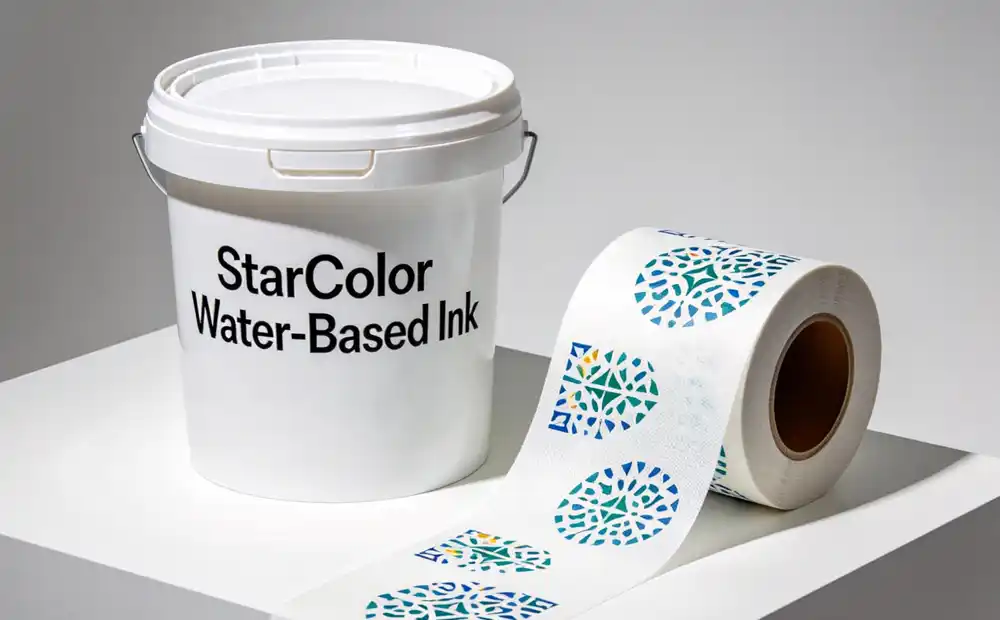
1. What Determines Ink Covering Power?
Covering power depends on three key factors:
- Pigment concentration (20–40%)
- Ink film thickness (controlled by anilox BCM)
- Substrate interaction (absorption & surface energy)
For example:
- White ink opacity: typically >85%
- Color density (flexo): 1.2–1.6 D
2. Root Causes of Low Opacity
2.1 Low Pigment Loading
Insufficient pigment reduces light scattering, especially in white inks where TiO₂ content is critical.
2.2 Incorrect Anilox Selection
Low anilox volume (e.g., <3 BCM) results in thin ink film and poor coverage.
2.3 Ink Penetration on Porous Substrates
On paper or nonwoven, ink penetrates instead of forming a surface film.
2.4 Improper Viscosity
- Too low → insufficient film thickness
- Too high → uneven transfer
2.5 No White Base Layer
On dark substrates, direct printing without white underprint leads to dull colors.
3. Proven Solutions (Based on Production Practice)
3.1 Optimize Pigment System
- Increase pigment loading to 25–35%
- Use high-opacity pigments (e.g., TiO₂ rutile type)
3.2 Adjust Anilox Roller
- White ink: 4–6 BCM
- Color ink: 3–4 BCM
3.3 Control Ink Viscosity
Recommended range:
- Flexo: 20–30 seconds (DIN cup)
3.4 Improve Substrate Surface
- Corona treatment: > 38 dyn/cm
- Apply primer for nonwoven or paper
3.5 Optimize Drying
- Temperature: 50–70°C
- Ensure proper airflow
3.6 Use White Underprint
Critical for:
- BOPP packaging
- Label printing
- Dark substrates
Can improve color strength by 30–50%
4. Quality Control Methods
- Drawdown test → evaluate opacity visually
- Density measurement → ensure consistency
- ΔE monitoring → control color deviation
5. Best Practices
- Match ink system with substrate type
- Use high-solid-content ink
- Regularly clean anilox rollers
- Test before mass production
Conclusion
Low covering power is not caused by a single issue—it is the result of ink formulation, substrate properties, and printing parameters.
By combining data-driven optimization and process control, printers can achieve:
- Higher opacity (>85%)
- Better color consistency
- Reduced production defects
For high-end packaging and label printing, improving ink covering power is not optional—it is essential for product quality and brand value.