RU
RU EN
EN CN
CN


The Advantages of Water-Based Inks in Printing: A Sustainable, Colorful, and Healthy Choice
Date: Oct 09 2023 From: Star Color Views:
“What are the advantages of water-based inks in printing?” is a common question for printing plants when selecting ink systems. The outdated belief that “eco-friendly inks compromise print quality” no longer applies. Today’s water-based inks deliver a strong balance of sustainability, vibrant color performance, and health safety, making them a mainstream solution for packaging and commercial printing worldwide.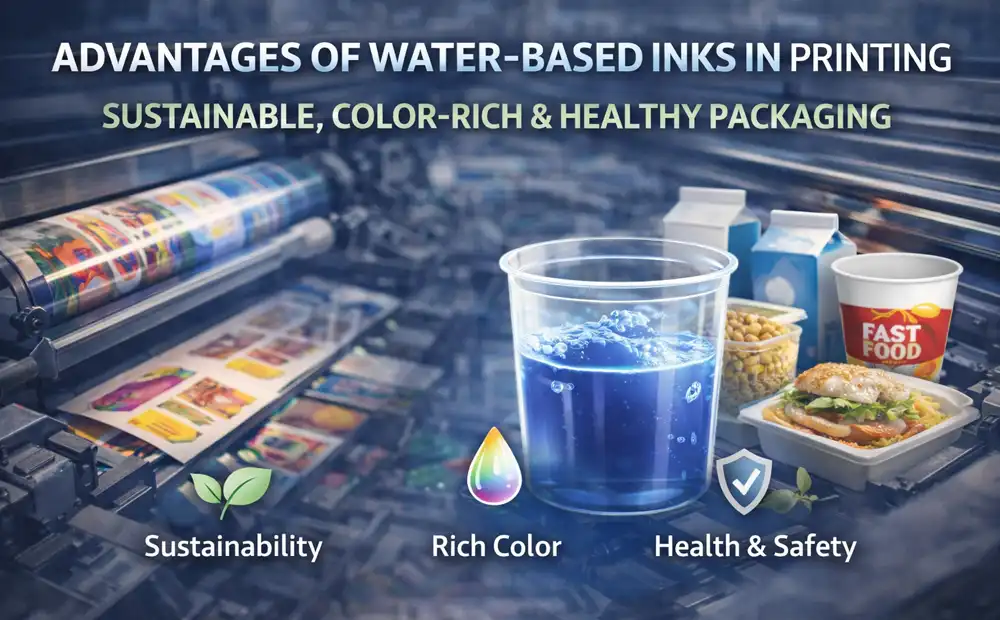
1. Sustainability: The Preferred Choice for Green Printing
Water-based inks are designed for full life-cycle environmental compliance, aligning with increasingly strict global regulations.
- Low VOC emissions: With water as the primary carrier, VOC levels are typically ≤50 g/L, and food-grade formulations can be significantly lower, reducing regulatory pressure and compliance costs.
- Lower operational costs: Equipment cleaning uses water or mild detergents, minimizing solvent consumption and waste disposal expenses.
- Recyclability: Printed paper and board can enter standard recycling streams without additional de-inking challenges, supporting circular packaging systems.
2. Rich Color Performance: No Compromise on Print Quality
Advances in resin chemistry and pigment dispersion have closed the performance gap between water-based and solvent-based inks.
- High solid content: Modern formulations achieve 35–45% solids, delivering dense ink films and strong opacity with controlled ink consumption.
- Accurate color reproduction: Pigment particle sizes typically range from 0.5–1.5 μm, enabling fine dot reproduction and stable color consistency with ΔE values ≤0.8.
- Flexible gloss control: Water-based inks can achieve matte to high-gloss finishes without additional coating processes.
3. Health & Safety: Protection for Workers and Consumers
Unlike solvent-based inks, water-based systems do not release hazardous aromatic solvents during printing.
- Safer production environments: Reduced airborne emissions improve workplace air quality and lower health risks for operators.
- Food-contact safety: Food-grade water-based inks comply with international standards such as FDA 21 CFR 175.300 and EU 10/2011, with extremely low migration and heavy metal content.
4. Addressing Common Concerns
Earlier limitations of water-based inks have largely been resolved by modern technology:
- Drying speed: With optimized hot-air or LED-assisted drying, surface drying can occur within seconds, supporting high-speed presses.
- Adhesion: Specialized formulations with coupling agents provide reliable adhesion on paper, board, and treated plastic films.
Conclusion
In 2026, water-based inks are no longer an “eco-friendly alternative” but a standard printing solution. By combining sustainability, strong visual performance, and health safety, they enable printers to meet regulatory demands while maintaining high-quality output. Choosing the right water-based ink for each application—such as food-grade packaging or high-color commercial printing—ensures both compliance and competitive advantage.