RU
RU EN
EN CN
CN


Color inconsistency ranks as one of the most costly and troublesome quality defects across water-based ink flexo and gravure printing. Unpredictable in-run color drift and batch-to-batch deviation against standard color chips directly trigger finished-product rejection, unnecessary rework, raw material wastage and brand-complaint risks from downstream clients. Compared with solvent-borne alternatives, water-based inks feature water-dominated dispersion systems, making them far more sensitive to viscosity fluctuation, ambient humidity swing, substrate absorption variance and inconsistent thermal drying conditions, which significantly raises the difficulty of stable color replication. Based on years of mass-production data, more than 60% of color-difference incidents originate from unstable ink viscosity and irregular ink transfer volume. This article classifies core inducements of color shift and puts forward closed-loop full-process control schemes covering raw ink management, precision equipment calibration, standardized production workflow and constant environmental regulation.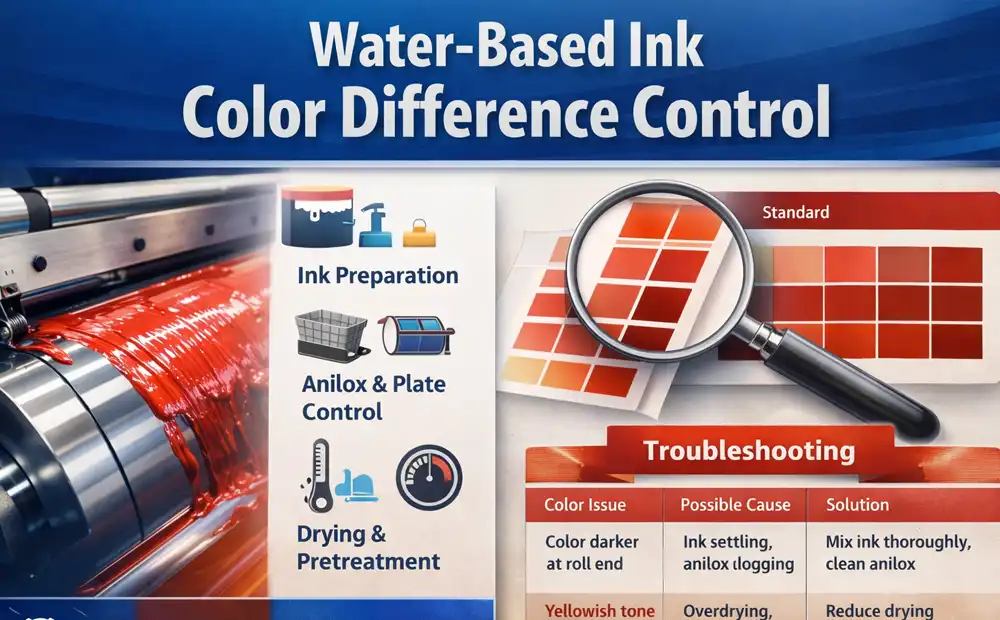
1. Core Root Causes of Printing Color Difference
Color drift of water-based ink is generally derived from four interrelated links throughout the whole production chain:
- Unstable ink formulation status: Irregular pigment proportion during tinting, random manual dilution, long-term storage induced pigment sedimentation and resin stratification break consistent tinting strength of finished ink.
- Deviated equipment operating status: Gradual wear of anilox cell volume, mismatched anilox line count, uneven impression pressure and unstable linear speed disrupt quantitative ink feeding.
- Unregulated production parameters: Improper drying temperature & airflow distribution, incomplete substrate surface pretreatment and inaccurate overprint registration lead to local color overlapping or uneven ink fixation.
- Variable substrate & ambient conditions: Fluctuated workshop temperature and relative humidity, inconsistent water absorption among different substrate batches and unstable inspection light source interfere final color presentation.
2. Front-End Source Control: Stabilize Original Ink Performance
2.1 Prevent pigment sedimentation and ink delamination
- Standardized storage specification: Keep ink sealed in dry and ventilated warehouse at 15–30°C, avoid direct ultraviolet sunlight irradiation and control shelf life within 12 months.
- Uniform pre-print stirring: Agitate bulk ink at 300–500 rpm for 10–15 minutes before tank filling to homogenize settled pigment fully.
- Formula anti-settling modification: Supplement 0.1%–0.3% fumed silica anti-settling additive to optimize ink thixotropy and restrain long-term solid particle precipitation.
3. Precision Equipment Management to Secure Stable Ink Transfer
3.1 Anilox roller graded selection & periodic maintenance
- Line count matching: 150–300 LPI for solid field & ordinary graphic printing; above 600 LPI for fine halftone dot reproduction; 120–200 LPI for high-opacity full-coating ink.
- Regular overhaul: Replace aging rollers once effective cell volume loss exceeds 10% to prevent gradual ink shortage and color fading.
- Speed coordination: Maintain the revolving speed ratio between anilox roll and printing cylinder within 1:1.2 ~ 1:1.5 for consistent ink pick-up.
3.2 Impression pressure & plate precision control
- Flexographic printing pressure is regulated at 0.1–0.3 MPa to avoid over-squeezing excess ink or insufficient ink transfer.
- Control cylinder radial runout below 0.01 mm and replace deformed or worn printing plates promptly once dot distortion appears.
4. In-Line Printing Process Optimization
4.1 Segmented gradient drying configuration
- Flexo setup: Pre-drying 40–50°C → Final curing 55–65°C;
- Gravure setup: Pre-drying 50–60°C → Final curing 65–75°C;
- Control circulating hot-air velocity at 2–3 m/s for homogeneous moisture evaporation; prohibit overheating which triggers ink oxidation yellowing and abnormal tone shift.
4.2 Substrate surface pretreatment specification
- Implement corona discharge treatment to lift substrate surface tension steadily at 38–42 mN/m for uniform ink spreading;
- Complete single-batch production with identical base material to eliminate absorption discrepancy among different paper/film lots;
- Coat water-based primer on high-absorption paper and non-woven fabrics to restrain excessive ink penetration leading to lighter printed color.
4.3 Overprint registration management
- Control longitudinal registration tolerance ≤0.1 mm and lateral tolerance ≤0.05 mm;
- Stabilize substrate unwinding tension within ±5 N to avoid web stretching deformation;
- Follow printing sequence: light-color first, dark-color later; transparent ink prior to opaque ink to prevent back-side color contamination.
5. Workshop Environment Constant Control
Stabilize production workshop at constant temperature 20–25°C and relative humidity ranging from 45% to 65%. Place sealed incoming ink in production workshop for 2–4 hours of temperature acclimatization before dosing into ink tank, which effectively avoids sharp viscosity fluctuation caused by temperature difference between stored ink and ambient air.
6. Quick Troubleshooting Table for Typical Color Abnormity
| Defect Phenomenon | Critical Root Cause | Targeted Solution |
|---|---|---|
| Color gradually darker toward roll tail | Pigment sedimentation / partial anilox cell clogging | Full re-stirring of ink; deep clean or replace clogged anilox roller |
| Entire printed sheet turns yellowish | Overdrying / poor heat resistance of selected pigment | Lower drying temperature; switch to heat-stable pigment-grade ink |
| Obvious color difference among production batches | Unstandardized ink matching / inconsistent substrate batches | Fix fixed ink formulation; arrange production with unified batch base material |
| Mottling & uneven patchy color | Unstable surface tension / ultra-fast ink surface drying | Optimize corona pretreatment; add proper leveling agent into ink formula |
Conclusion
Qualified color consistency of water-based ink printing relies on systematic full-chain management: stabilized ink formula, precise periodic equipment maintenance, refined parameterized printing process and constant production environment. Adopting preventive management mode combined with real-time color density testing and dynamic parameter adjustment is the core approach to minimize color difference, reduce scrap rate and improve overall production profitability.