In flexographic UV printing, tape adhesion tests may show partial ink smudging or full‑sheet ink delamination. Many production sites simply increase UV lamp power or reduce press speed, which fails to resolve defects and often makes curing issues worse.
Proper root‑cause analysis is critical for effective troubleshooting. Drawing on years of real‑world printing‑industry experience, this article summarizes typical causes and practical solutions for incomplete UV‑ink curing.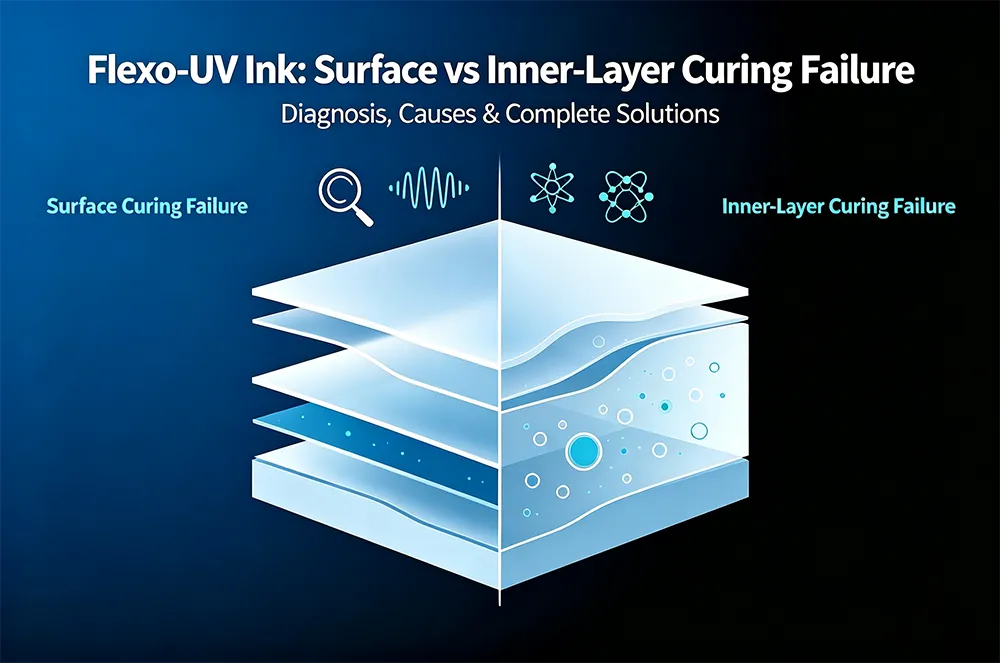
1. Surface Curing Failure
1.1 Typical Visual Symptoms & Diagnosis
Defects occur exclusively on the ink surface, while adhesion between the ink bottom layer and substrate remains normal.
- Tacky / sticky surface: Fresh‑printed ink feels greasy, fingerprints remain after touching.
- Blocking on rewinding: Printed surface sticks to the reverse‑side substrate during rewinding or stacking, causing ink transfer and scuffing.
- Poor scratch resistance: Ink scratches off easily, soft surface without a firm dry film.
- Poor alcohol and rub resistance: No dense cross‑linked surface film is formed.
- Normal substrate adhesion despite sticky surface: Tape test shows no ink delamination; bonding at the ink‑substrate interface is intact.
1.2 Root Causes of Surface Curing Failure
Approximately 90 % of surface‑curing problems stem from oxygen inhibition and insufficient surface UV energy, unrelated to light penetration through the ink layer.
- Oxygen inhibition (primary cause): In radical‑type UV curing, atmospheric oxygen traps free radicals on the ink surface and terminates cross‑linking reactions. Flexo printing features high press speed, thin ink layers and short exposure time. The open‑air surface is highly susceptible, especially for light‑colored, high‑gloss and large solid‑area prints.
- Degraded UV lamp output: Lamp ageing, dirty reflectors reduce effective UVC energy input and incomplete surface cross‑linking.
- Excessive press speed: Peak irradiance may be sufficient, yet total cumulative energy (mJ/cm²) is too low for full surface curing.
- Ink formulation issues: Insufficient surface‑active photoinitiators, excessive diluents, high‑content matte fillers hinder surface‑layer reaction.
- Hot rewinding after curing: Fresh‑cured hot ink film suffers thermal re‑tack when rolled immediately.
1.3 Solutions for Surface Curing Failure
- Reduce press speed moderately to raise total UV exposure energy and ensure complete surface cross‑linking.
- Replace UV lamps on schedule and clean reflectors regularly to avoid energy loss.
- Select flexo‑UV inks formulated for anti‑oxygen‑inhibition performance to improve anti‑blocking properties.
- Adopt nitrogen‑purged curing if available to eliminate oxygen‑inhibition effects.
- Strictly avoid adding non‑reactive solvents or water‑based diluents.
- Fully cool printed webs before rewinding; lower winding tension to prevent thermal re‑tack and blocking.
2. Inner‑Layer (Sub‑Surface) Curing Failure
2.1 Typical Visual Symptoms & Diagnosis
Contrary to surface‑curing defects: the ink surface looks dry and non‑tacky, yet inner and bottom‑ink layers remain under‑cured. This is a hidden defect difficult to detect.
- Dry‑to‑touch surface, yet full‑sheet ink delamination in tape test: well‑cured skin layer while bottom‑layer cross‑linking fails, resulting in extremely poor adhesion.
- Post‑lamination blistering, delamination or layer separation: defects appear 1‑2 days or weeks after production.
- Soft and sticky inner ink: when scraping through the hard outer skin, the inner ink remains paste‑like and uncured.
- Solvent wipes penetrate through the ink film: outer skin is cross‑linked but inner structure remains unreacted.
- Late‑stage re‑tack: products look normal off‑press but turn sticky after storage.
Diagnosis rule‑of‑thumb: Dry‑to‑touch surface + poor adhesion + lamination blisters + soft inner ink = inner‑layer curing failure.
2.2 Root Causes of Inner‑Layer Curing Failure
Essence: UV light cannot penetrate the ink layer, so the bottom receives insufficient effective photon energy. Oxygen‑inhibition is not the driving factor.
- Pigment light‑shielding (dominant cause): High‑loading pigments such as carbon black, deep blue, bright red and dark green absorb UV radiation. Light cannot reach the ink‑substrate interface. A hard surface skin forms while the bottom stays uncross‑linked.
- Excessive ink‑film thickness: Heavy solid‑ink build‑up in flexo printing limits UV‑light penetration and creates “hard skin, raw base” effect.
- Misoperation: Simply increasing UV‑lamp power: Higher power accelerates surface skin formation and further blocks light penetration, worsening inner‑layer under‑curing.
- Spectral mismatch: LED‑UV wavelength does not match deep‑cure photoinitiators in the ink; only surface‑layer reactions take place.
- Contaminated substrate interface: Migration of slip agents, oil residues or moisture on film substrates terminates polymerization at the ink‑substrate boundary.
- Ink lacks deep‑cure photoinitiators: Formulation only contains short‑range surface‑type photoinitiators without long‑wavelength components for deep‑layer curing.
2.3 Solutions for Inner‑Layer Curing Failure
- Do not merely increase UV‑lamp power. Slow down press speed, apply multi‑pass exposure or dual‑lamp curing to improve overall light‑transmission energy.
- For dark solid areas: adopt multiple thin‑layer over‑printing instead of one‑pass heavy‑ink deposition to facilitate UV‑light penetration.
- Switch to high‑penetration flexo‑UV inks designed for dark‑color and thick‑film deep‑curing applications.
- Ensure UV‑lamp spectrum matches the photoinitiator system of selected UV ink.
- Improve substrate corona treatment; remove surface slip‑agent precipitation and contaminants to secure clean ink‑substrate interface.
- Run accelerated ageing tests before mass production to prevent post‑lamination blistering and delamination risks.
3. Quick‑Reference Troubleshooting Table
- Surface Curing Failure: Sticky surface, blocking, easy scratching, greasy appearance, normal adhesion → Root causes: oxygen inhibition & insufficient surface UV energy.
- Inner‑Layer Curing Failure: Dry‑to‑touch surface, ink delamination, lamination blisters, soft inner ink → Root causes: poor UV‑light penetration, pigment light‑shielding, excessive ink‑film thickness.
4. Summary
For flexo‑UV curing defects: surface‑layer issues focus on oxygen inhibition and surface energy; inner‑layer issues focus on light penetration, ink‑film thickness and spectral matching. Most rework cases arise from mis‑diagnosing inner‑layer under‑curing as surface‑stickiness, followed by blindly boosting lamp power or adjusting press speed, which makes defects recurrent. Accurate differentiation of the two failure modes plus targeted adjustments of process parameters and ink formulations can resolve stubborn issues including uncured ink, delamination, blistering and post‑storage re‑tack.