In food packaging, any material that comes into direct or indirect contact with food must meet strict safety requirements. Among these materials, food grade water-based ink plays a crucial role by ensuring safe printing while minimizing environmental impact.
Unlike conventional inks used for non-food applications, food grade water-based inks are specifically formulated to prevent harmful substance migration into food. They combine food safety compliance, low VOC emissions, and reliable print performance, making them a preferred solution for modern food packaging.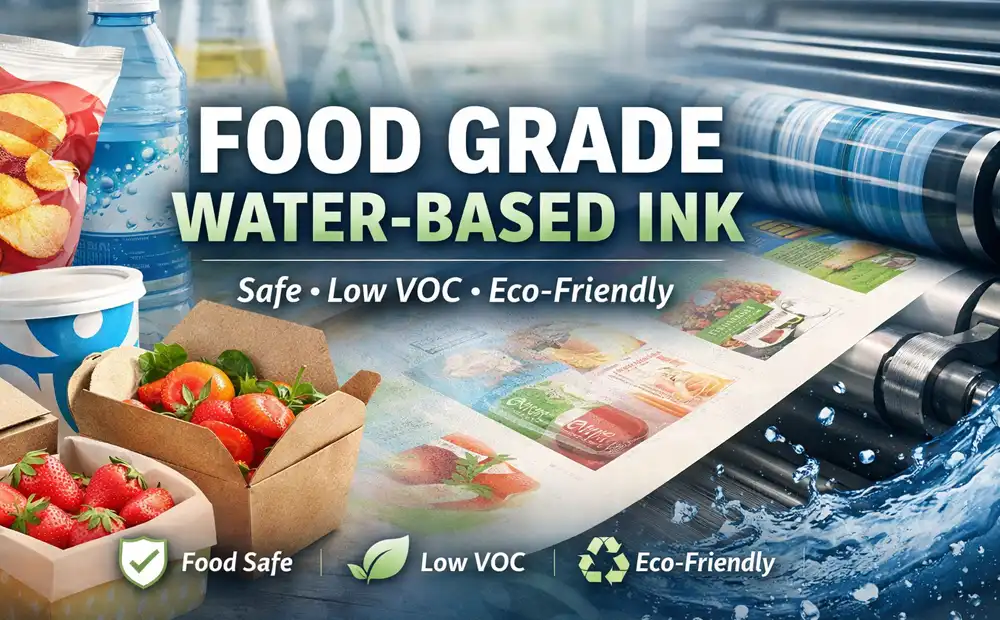
Definition: What Makes an Ink “Food Grade”?
Food grade water-based ink uses water as the primary solvent, instead of organic solvents such as toluene or xylene. However, being “food grade” goes far beyond being simply water-based.
These inks are formulated exclusively with approved resins, pigments, and additives that meet food contact regulations. Every component is selected to ensure that, once printed and dried, the ink does not release harmful substances when exposed to food under real-world conditions.
Food grade water-based inks are suitable for both direct and indirect food contact, including applications such as flexible packaging, paper food containers, and certain biodegradable or edible materials.
Key Characteristics of Food Grade Water-Based Ink
1. Extremely Low Migration Risk
Migration safety is the core requirement. Food grade inks use high-molecular-weight resins that form a stable ink film, effectively preventing pigments or additives from transferring into food. Pigments are free from heavy metals and other restricted substances.
2. Low VOC and Eco-Friendly
Because water replaces organic solvents, VOC emissions are significantly reduced. This supports compliance with global environmental regulations while also improving workplace safety for printing operators.
3. Broad Substrate Compatibility
Food grade water-based inks are designed for common food packaging substrates such as paper, paperboard, PE, PP, PET, and laminated films. Modified resin systems improve adhesion, even on low-surface-energy plastics.
4. Reliable Durability
These inks offer resistance to abrasion, moisture, and temperature variations. Specialized formulations can withstand heat treatments such as pasteurization or retort processing without color degradation or adhesion loss.
5. Stable Print Quality
Despite the safety focus, food grade water-based inks still deliver sharp graphics, consistent color strength, and good opacity, making them suitable for both branding elements and regulatory labeling.
Regulatory Compliance: EU and US Standards
European Union (EU)
Food grade water-based inks used in the EU must comply with Regulation (EU) No 10/2011 on food contact materials. Key requirements include:
-
Use of substances listed on the EU positive list
-
Compliance with overall and specific migration limits
-
Restrictions on hazardous substances under REACH
United States (US)
In the US, food contact inks are regulated under FDA 21 CFR, including:
-
21 CFR 175.300 for printing inks
-
21 CFR 176.170 for paper and paperboard food packaging
Manufacturers typically provide a Declaration of Compliance (DoC) and migration test data to demonstrate conformity.
Common Applications
Food grade water-based inks are widely used in:
-
Flexible packaging: snack bags, candy wrappers, beverage labels
-
Paper-based packaging: food cartons, bakery bags, takeaway boxes
-
Rigid containers: paper cups, plastic trays, yogurt lids
-
Biodegradable and compostable packaging
How to Choose the Right Food Grade Water-Based Ink
When selecting an ink, consider:
-
Regulatory compliance for target markets
-
Substrate compatibility and adhesion performance
-
End-use conditions, such as heat, moisture, or fatty food contact
-
Printing process, including flexography or gravure
-
Sustainability goals, such as low VOCs and energy-efficient drying
Conclusion
Food grade water-based ink is a critical component of safe and sustainable food packaging. By combining low migration risk, environmental responsibility, and regulatory compliance, it helps protect consumers while supporting modern packaging demands.
As food safety regulations continue to tighten and brands place greater emphasis on sustainability, food grade water-based inks will remain a key solution for compliant, high-quality food packaging worldwide.