RU
RU EN
EN CN
CN


Characteristics and advantages of plastic film waterborne flexographic printing ink
Date: Oct 17 2023 From: Star Color Views:
With stricter environmental regulations and increasing demand for food-safe packaging, water-based flexographic ink for plastic films is becoming a mainstream alternative to solvent-based systems. However, its real value lies not only in “eco-friendly” claims, but in measurable performance, process compatibility, and application reliability.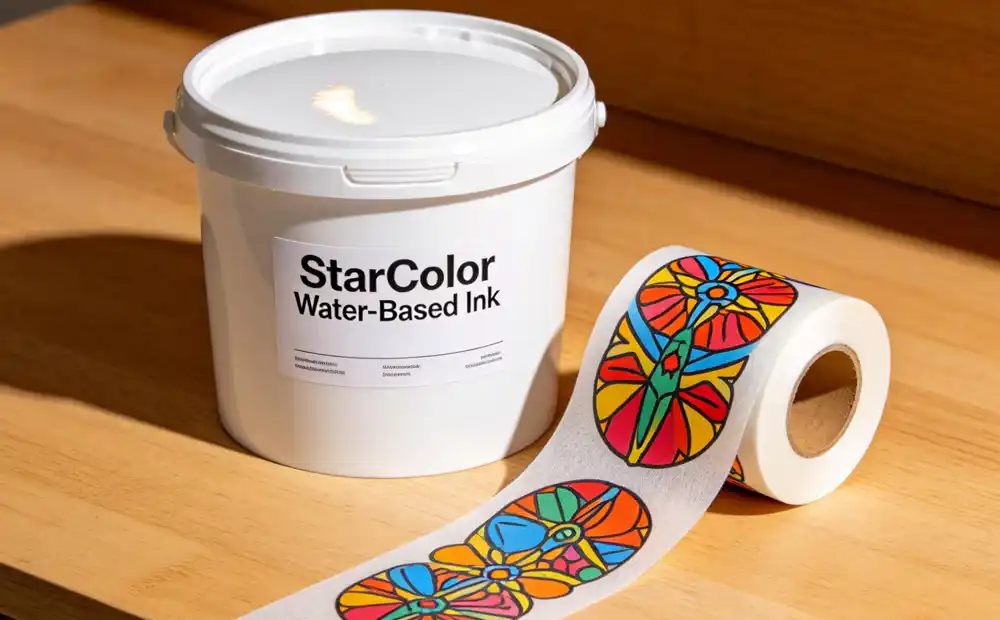
1. Key Performance Data (Not Just Claims)
| Property | Typical Value | Industry Benchmark |
|---|---|---|
| VOC Content | < 5% | 30–60% (solvent ink) |
| Adhesion (BOPP) | 4B–5B | ASTM D3359 |
| Drying Time | 30–90 seconds | Hot air drying |
| Rub Resistance | >200 cycles | ASTM D5264 |
| Gloss | 60–85 GU | High-quality packaging |
These data points demonstrate that modern water-based inks can meet most packaging requirements when properly optimized.
2. Core Advantages in Real Production
2.1 Compliance & Food Safety
Low VOC and low migration formulations make water-based inks suitable for food packaging, pharmaceutical packaging, and children’s products, helping manufacturers meet FDA and EU regulations.
2.2 Lower Total Cost (Not Just Ink Price)
- No solvent recovery system required
- Reduced exhaust treatment cost
- Safer storage and transportation
Total production cost can be reduced by 10–30% in long-term operation.
2.3 High-Speed Printing Compatibility
With proper drying systems, water-based inks can run at 120–200 m/min in flexo printing lines, maintaining stable print quality.
3. Common Problems & Solutions (Most Important Section)
Problem 1: Poor Adhesion on BOPP / PE
Cause: Low surface energy (<38 dyn/cm)
Solution:
- Corona treatment > 38 dyn/cm
- Use modified resin ink
- Add adhesion promoter
Problem 2: Slow Drying
Cause: High humidity / insufficient airflow
Solution:
- Increase hot air temperature (50–70°C)
- Improve air circulation
- Add co-solvent
Problem 3: Low Color Strength
Cause: Ink penetration or low solid content
Solution:
- Use high solid ink
- Adjust viscosity
- Optimize anilox roller
4. Water-Based vs Solvent-Based Ink (Quick Comparison)
| Feature | Water-Based Ink | Solvent Ink |
|---|---|---|
| VOC Emission | Low (<5%) | High (30–60%) |
| Safety | High | Flammable |
| Environmental Impact | Low | High |
| Drying Speed | Medium | Fast |
5. Application Areas
- Flexible packaging (snacks, frozen food)
- BOPP / PET film printing
- Label printing
- Hygiene and medical packaging
6. Future Trends
- Bio-based resin systems
- Ultra-low migration ink
- High-speed drying technology
- Functional inks (UV resistance, antibacterial)
Conclusion
Water-based flexographic ink is no longer just an “eco-friendly alternative.” With continuous improvements in adhesion, drying, and print quality, it is becoming a practical, scalable solution for modern plastic film printing.
For converters, the key is not whether to use water-based ink, but how to optimize it for their specific substrate and production conditions.