RU
RU EN
EN CN
CN


Direct food contact inks are a key regulatory focus under both the EU “Farm to Fork” strategy and the U.S. FDA food safety framework. In packaging applications such as biscuit wrappers, yogurt cups, and baby food containers, the compliance level of the ink directly determines whether a product can legally enter mainstream EU and U.S. markets.
While the EU regulatory framework is primarily anchored in Regulation (EU) No 10/2011 and the U.S. in FDA 21 CFR 175.300, regulatory enforcement in 2025 has become significantly stricter. The EU has enhanced migration detection sensitivity, while the FDA has reinforced traceability and import control for food contact inks.
For food exporters and contract printers serving multinational brands, the following five compliance standards represent both the mandatory market entry threshold and the critical red line for recall risk prevention.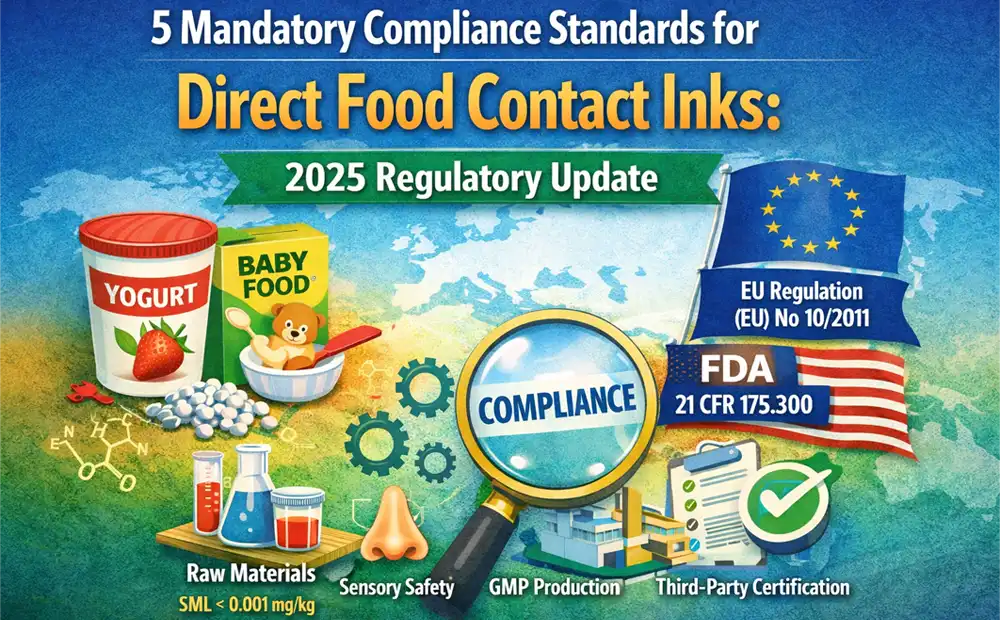
I. Raw Material Positive List Compliance
Both the EU and the U.S. apply a positive list system for direct food contact inks, meaning only substances explicitly permitted by regulation may be used.
- Approved resins: Resins must be based on FDA-approved acrylic copolymers or polyurethane systems. In EU-aligned compliance, residual monomers must meet applicable SML requirements (e.g., methacrylate migration limits).
- Restricted substances: REACH Annex XVII restricts benzene and certain phthalates. Azo colorants must comply with EU 2002/61/EC regarding aromatic amines. The FDA restricts PAHs in food contact applications.
- Raw material purity: Pigments such as titanium dioxide are expected to meet pharmacopeia-grade impurity control, with extremely low heavy metal contamination.
II. Migration Limit Requirements
Migration safety remains the core of regulatory assessment. Although EU Regulation (EU) No 10/2011 does not directly regulate inks, its migration framework is widely adopted as a compliance benchmark.
From 2025, EU laboratories have significantly improved analytical sensitivity, with detection limits commonly reaching 0.001 mg/kg for certain substances.
- Overall migration: The EU reference limit is 10 mg/dm² (or 60 mg/kg), while FDA compliance relies on food simulant testing under defined time and temperature conditions.
- Specific migration: Photoinitiators and additives must comply with individual SMLs. BPA is subject to extremely strict control in both EU and U.S. markets.
- Heavy metals: For infant food packaging, migration limits are significantly more stringent than for general food applications.
III. Sensory and Odor Safety Standards
In addition to chemical safety, sensory performance is a frequent cause of recalls. EU EN 1230-2 and FDA sensory assessment guidance emphasize the absence of odor, taste, and secondary contamination.
- Ink film integrity: The ink layer must remain intact after folding, filling, and thermal processing.
- Odor neutrality: Sensory panels must confirm that no detectable off-odors are transferred to food or simulants.
IV. Manufacturing and GMP Compliance
The EU requires GMP-compliant production for food contact materials, while the U.S. enforces CGMP under FDA oversight.
- Production environment: Cleanroom management, filtration systems, and contamination control are mandatory.
- Cross-contamination prevention: Food contact inks must be physically segregated from industrial inks.
- Environmental compliance: VOC emissions are strictly controlled, favoring water-based and solvent-free formulations.
V. Third-Party Testing and Certification
Neither EU nor U.S. regulators accept self-declared compliance for direct food contact inks. Independent third-party testing is mandatory.
- EU market: Full migration testing aligned with EU 10/2011 by accredited laboratories (e.g., SGS, TÜV).
- U.S. market: FDA-compliant documentation supported by third-party testing and traceable raw material records.
- International reference: Codex-aligned testing frameworks can help reduce duplicated assessments across markets.

Conclusion
In 2025, regulatory scrutiny of direct food contact inks will continue to intensify. From raw material selection and migration safety to sensory performance, GMP production, and third-party certification, every compliance element is non-negotiable.
These five standards form a complete compliance system for EU and U.S. market access. Any weakness may become a critical barrier—or a trigger for costly recalls.